
Why do I sound weird on video?
In this article
- Why does my voice sound different on a recording?
- Does adding bone conduction make it sound like me again?
- Is it normal to hate the sound of your voice on video?
- Do other people like my voice more than I do?
- Am I louder than I think?
- How do I make my voice sound better on video?
- How do I get used to my own voice on video?
- Common questions
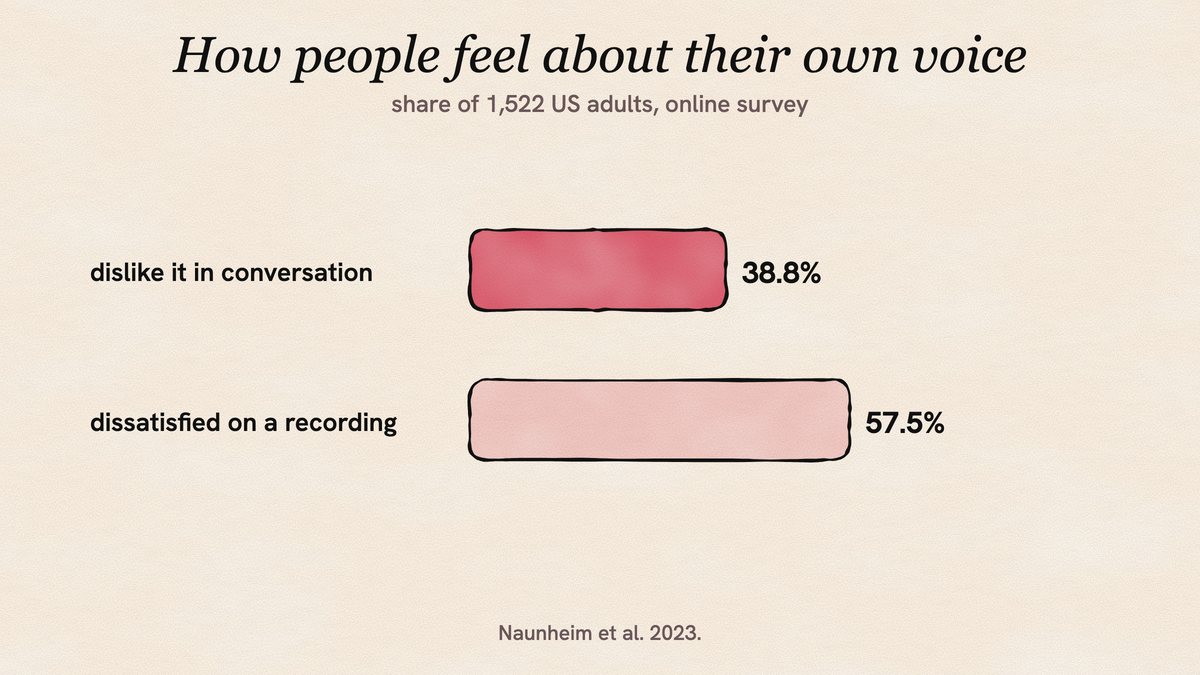
Most people are fine with their voice until they hear it played back. In a survey of 1,522 US adults, 38.8% said they didn't like the sound of their own voice in normal conversation 1. Asked about listening to a recording of their voice, 57.5% said they were unhappy with it 1.
That jump is the whole puzzle. Same voice, same person, and yet the recorded one wins a lot more critics. The reason starts inside your head.
Why does my voice sound different on a recording?
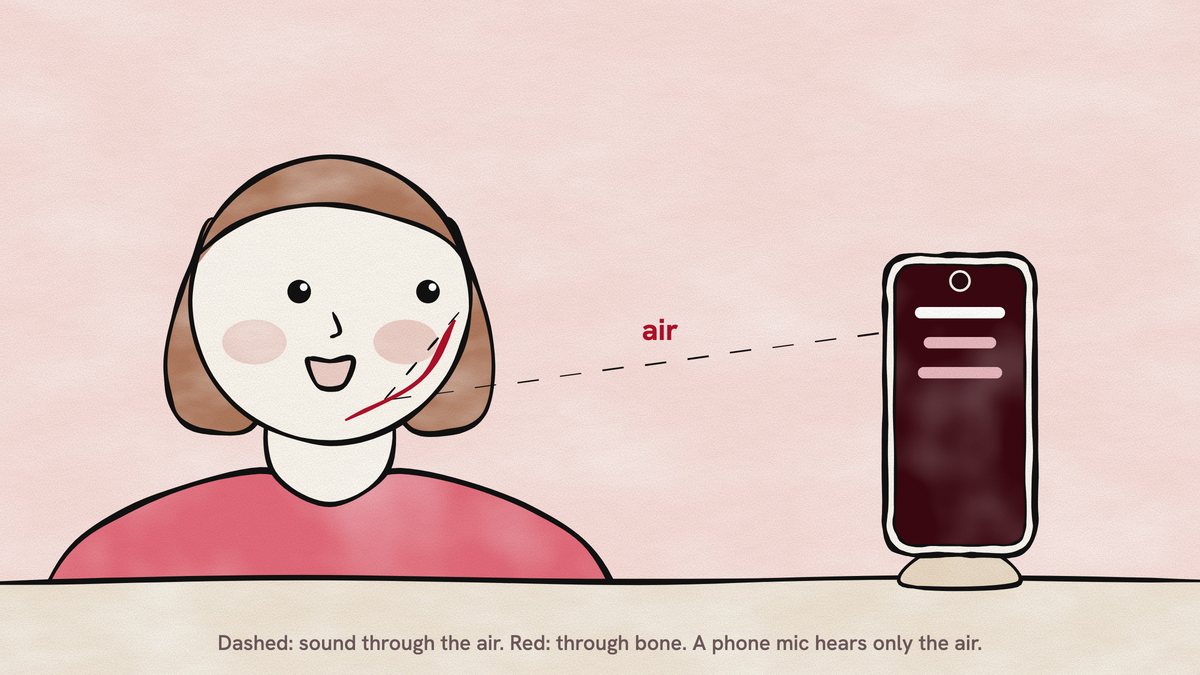
Your voice reaches your own ears by two routes, and a microphone only gets one of them. One route is through the air, from your mouth around to your ears, the way everyone else hears you. The other is through the bones and tissue of your head, straight to your inner ear.
The bone route carries a lot of the sound. A Swedish team measured both routes while people produced ten different speech sounds. For most of them, the bone-conducted part of the voice dominated at frequencies between 1 and 2 kHz 2.
A phone's microphone sits outside your head. It picks up only the air route, so the voice it records is missing the part you're used to. A Swiss-led team put it plainly: your voice "is perceived as strange when played back in a recording. One of the main reasons is the lack of bone conduction" 3.
Does adding bone conduction make it sound like me again?
In a lab, it helped people pick out their own voice. In three studies, the same team played recorded voices with added bone-conducted vibration, imitating what happens when you speak. People got better at telling their own voice from someone else's when it came through bone instead of air 3. Their own voice was also more often confused with a familiar person's voice than with a stranger's 3.
So the recording is much closer to what a listener hears. It just isn't the version of you that you've heard your whole life.
Is it normal to hate the sound of your voice on video?
It's very common, and it has been described for decades. In 1966, Holzman and Rousey reported that two groups of people who listened to their own recorded voices experienced "an affective disturbance" 4. In plain words, it upset them.
A 2024 study of 176 bilingual adults, with Arabic as their first language and English as their second, found that people with more social anxiety tended to dislike the sound of their voice more, especially in their first language 5. That's a link, and the study can't say which comes first. It hints that how we feel about ourselves plays a part in the wince.
In the US survey, unhappiness with one's voice was linked to being middle-aged, female and white 1.
Do other people like my voice more than I do?
You might like it more yourself when you don't know it's you. In one study, eighty men and women rated a set of voice recordings without being told that their own voice was among them 6. They rated their own voice as more attractive than other people rated it, and more attractive than they rated everyone else's 6.
That's a small lab study, and the abstract doesn't say how many people recognised their own voice. It does hint that the shock of a recording comes partly from knowing it's you.
Am I louder than I think?
Probably, by quite a lot. In a 2026 study, people spoke greetings and neutral sentences and then estimated how loud they sounded to a listener. They underestimated their own voice by around 10 dB, which means they spoke louder than they thought 7. When they judged a recording of their voice instead of speaking, the gap was 0.4 dB 7. The authors suggest the error comes from the act of speaking itself, through built-in damping such as a reflex in the middle ear 7.
For video, that's mildly reassuring. You judge the loudness of a recording well. It's your live impression of your voice that's off.
How do I make my voice sound better on video?
You can't add the bone path back, but you can stop the room and the mic from making things worse. These tips come from recording practice, not from the studies above.
- Get the phone closer, or use a mic. A built-in mic a few metres away picks up more room and less you. Put the phone on a stand at arm's length, or clip a small mic to your collar.
- Kill the echo. Hard, empty rooms bounce sound back. Film in a room with a sofa, curtains, a rug or a full bookshelf. A wardrobe of clothes behind the camera works surprisingly well.
- Watch the noise. Fridges, fans and traffic fill the gaps between your words. Switch off what you can.
- Speak at your normal level. Since you're probably louder than you think 7, there's no need to push.
- Listen with headphones. Phone speakers are tiny and thin. Judge your takes on headphones before you decide you hate them.
How do I get used to my own voice on video?
Listen to it more. We found no study that tested repeated listening as a way to like your recorded voice, so treat this as advice. Researchers name the missing bone conduction as one of the main reasons for the strangeness 3, and that part won't change. Familiarity can. The recorded version is the one your audience has always known, and the more you hear it, the more ordinary it becomes.
A good habit is to record short takes and play every one back. When you read from a script, you're free to listen to how you sound instead of what you'll say next. YapPlease can also read your script aloud before you film, which is a different thing from hearing yourself, but a handy way to hear the rhythm.
Common questions
Do you sound different on video than in real life?
To other people, no. A recording catches your voice through the air, which is how everyone else hears you. To you, yes, because when you speak you also hear yourself through the bones of your head, and that bone path is strong between 1 and 2 kHz for most speech sounds 2. The recording is missing that part.
Is the voice on a recording what I really sound like?
It's close to what listeners hear, though a phone's mic and speaker colour it a little. Researchers describe your recorded voice as sounding strange to you, with one of the main reasons being that it lacks the bone conduction you hear while speaking 3.
Why do I hate hearing my voice on video?
You're in big company. In a survey of 1,522 US adults, 57.5% were dissatisfied with their voice on a recording, compared with 38.8% who disliked it in normal conversation 1. In a study of 176 bilingual adults, disliking your own voice was linked to higher social anxiety 5.
Does everyone think their voice sounds weird on recordings?
Not everyone, but most people in the one large survey we found. Of 1,522 US adults, 57.5% were unhappy with their recorded voice 1. In a lab study, eighty people who didn't know their own voice was in the set rated it as more attractive than others did 6.
Sources
- Naunheim MR, Puka E, Huston MN (2023). Do you like your voice? A population-based survey of voice satisfaction and voice enhancement. Laryngoscope 133(12):3455-3461. PubMed
- Reinfeldt S, Ostli P, Håkansson B, Stenfelt S (2010). Hearing one's own voice during phoneme vocalization: transmission by air and bone conduction. Journal of the Acoustical Society of America 128(2):751-762. PubMed
- Orepic P, Kannape OA, Faivre N, Blanke O (2023). Bone conduction facilitates self-other voice discrimination. Royal Society Open Science 10(2):221561. PubMed
- Holzman PS, Rousey C (1966). The voice as a percept. Journal of Personality and Social Psychology 4(1):79-86. PubMed
- Jogia J, Thomas J, Barbato M, Bentall R (2024). Social anxiety, voice confrontation and voice recognition: A bilingual exploration. International Journal of Psychology 59(6):1084-1090. PubMed
- Hughes SM, Harrison MA (2013). I like my voice better: self-enhancement bias in perceptions of voice attractiveness. Perception 42(9):941-949. PubMed
- Toyomura A, Tamura Y, Nakabayashi K, Smith DRR (2026). Accuracy of speaker's self-estimation of their own voice. Journal of the Acoustical Society of America 160(5):3743-3753. PubMed
Keep reading
How to be confident on camera
You look calmer than you feel. What speaking research says about nerves, "get excited" self-talk and practice, and steps to try before your next take.
Talking head video setup on an iPhone
Sound first, then phone height, distance, window light, framing and takes. A simple talking head setup with the research that exists behind it.
How to sound natural reading a script
Listeners can hear reading even with the words filtered out. What small speech studies show about why scripts sound read, and how to fix yours.