
How to look at the camera while reading a script
In this article
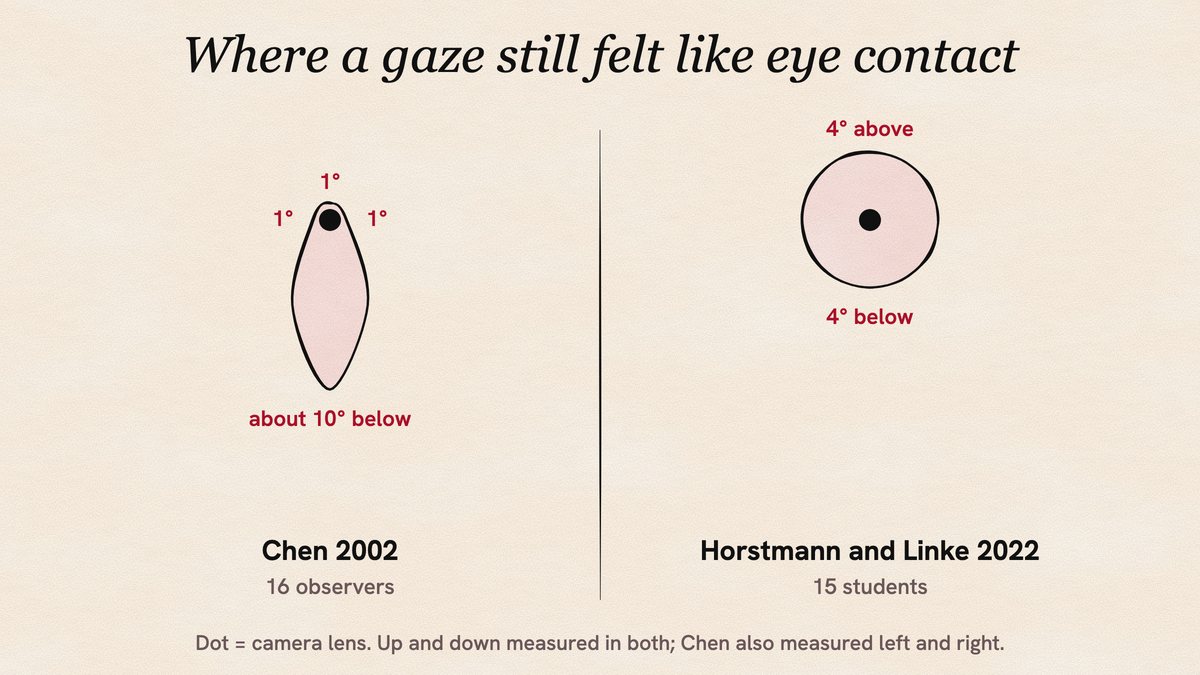
Engineers worried about this problem long before phones had cameras. While designing a video phone, Bell Laboratories found that eye contact was lost once a caller looked about 4.5 degrees to the side of the camera, or 5.5 degrees above or below it 1. A 2022 paper dates that work to 1969 and says its numbers fit the newer paper's own results 2.
So you don't have to stare into the glass. You need to look close enough, and "close enough" can be measured.
What is the cone of gaze?
The cone of gaze is the range of directions in which someone's eyes still feel aimed at you. Researchers Gamer and Hecht chose the image of a cone for this range of directions that counts as "looking at" another person 4. In their four experiments, the direction of the cone shifted with many things. Its angular width stayed fairly stable 4.
Other teams have measured how wide it is. One found the cone to be "an almost perfect cone", stable between 1.6 m and 7.9 m, with an average diameter of 5.2 degrees 3. Another paper sums up earlier research as eye rotations up to 4 to 9 degrees that people accept as direct gaze 5.
Because it is an angle, the area it covers grows with distance 3. A gaze 3 cm off the lens is a bigger angle when you are close to the camera than when you are farther away.
How far from the lens can you look and still make eye contact?
The answer depends on which study you trust, and the two main video studies disagree about looking down.
In 2002, Milton Chen filmed a man looking at points around a camera and showed the clips to 16 observers, Stanford students and recent graduates. Looking up, left or right, the man could look at most 1 degree away from the camera before observers stopped feeling eye contact 1. Looking down was far more forgiving. Chen reported that people were "an order of magnitude less sensitive" to gaze below their eyes, and the curves for four different lookers bent at roughly 10 degrees below the camera 1.
A 2022 study came to a different view. Fifteen students judged pictures of a person on a desktop screen whose eyes were turned up or down. They felt looked at across about 4 degrees either side of the best direction, and the authors describe the cone as "approximately symmetrical vertically" 2. They write that their results are at odds with Chen's case for a camera above the screen 2. They also suggest Chen's low video resolution and 2.4 m viewing distance may have stretched his cone downward 2.
On a phone the lens sits at the top edge, so below is where your words will be anyway. Both studies leave room there: about 4 degrees in the 2022 study and far more on Chen's numbers 12. The 2022 study also found that eyes turned very slightly upward looked the most direct 2, so the closer your words sit to the lens, the better.
Where should the script sit on your phone?
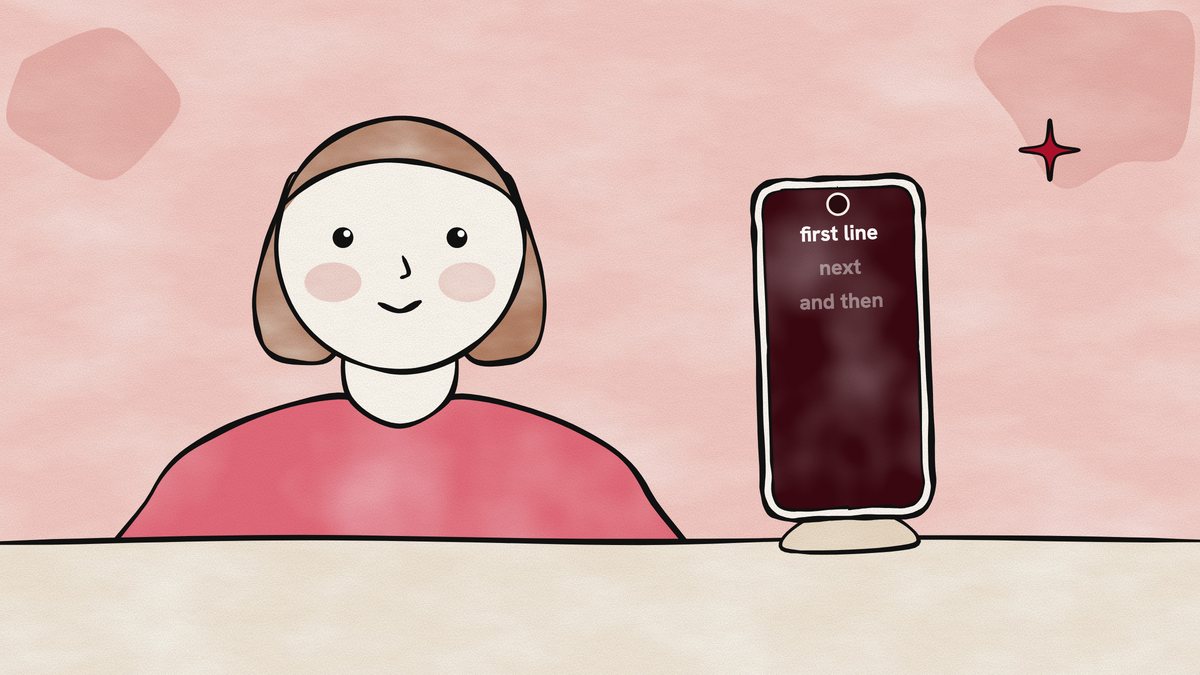
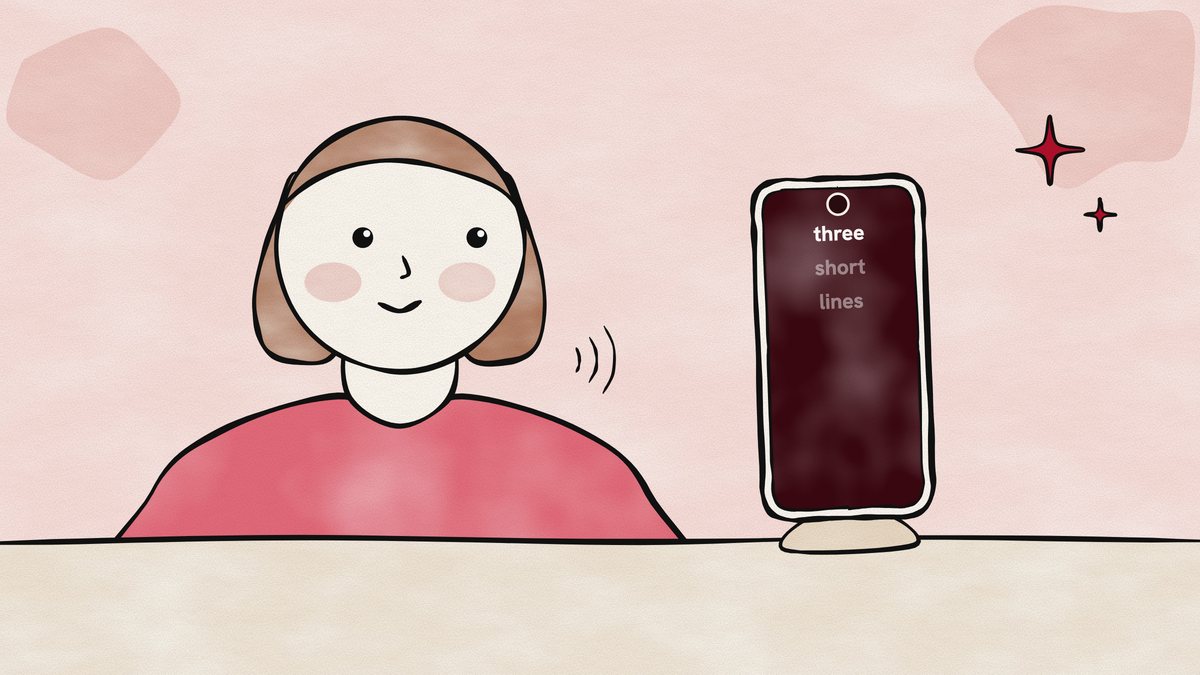
Put the first line you read as close under the lens as you can, in a narrow column. The geometry decides the rest.
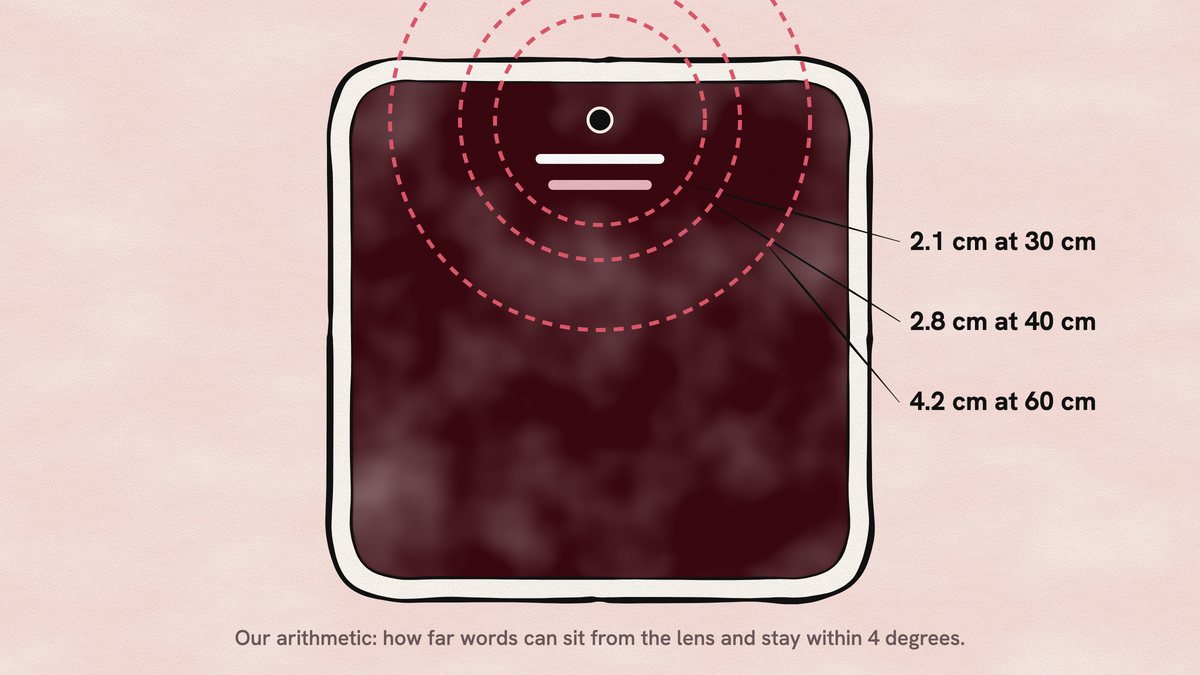
Here is our arithmetic for how far from the lens a word can sit and stay within 4 degrees, the band the 2022 study measured for up-and-down gaze 2. The distance is the tangent of 4 degrees times the distance from your eyes to the phone:
- 30 cm away: about 2.1 cm from the lens.
- 40 cm away: about 2.8 cm.
- 60 cm away: about 4.2 cm.
The authors of that study did a similar sum for a laptop. With a 10 degree cone and a screen 57 cm away, they say the speaker's gaze must land within a 5 cm radius of the camera 2. A phone at arm's length gives you a few centimetres to play with. A phone held close to your face gives you very little.
There is one more hint in the 2022 paper. In a second experiment with 12 participants, the cone for left and right gaze widened when the picture was made smaller 2. Viewers on a phone see you small. That may give you a little extra room, though the study used a desktop monitor and we found no test on phones.
Does eye contact with the camera matter to viewers?
Looking into the lens seems to help people remember what you said. In one study, a presenter on video gazed at the camera for 30% of a sales pitch in one version and not at all in the other. Viewers recalled significantly more of the version with camera gaze 6. When the same pitches were played as audio only, the difference disappeared 6, which suggests the effect came from what viewers saw.
More eye contact isn't always more persuasive. In a study where participants watched videos of speakers on controversial issues, those who looked more at the speaker's eyes changed their views less 7. In a second study, viewers told to watch the eyes of speakers arguing against their own views were persuaded less than viewers told to watch the mouth 7. That research is about where viewers looked, and about topics they already disagreed with. It doesn't say you should avoid the lens.
What doesn't the research show?
We found none of these studies measuring the cone of gaze for phone video watched on a phone. The samples are small, often 12 to 16 people 12, and the two main video studies disagree about looking down. The recall and persuasion abstracts don't say how many people took part 67. Use the numbers as a guide to where to put the words, then check your own footage.
Steps to try today
- Set the phone at eye height so the lens is level with your eyes.
- Move it to arm's length or a little farther.
- Place the script in a narrow column starting right under the lens.
- Film 20 seconds and watch it back on the phone, at the size your viewers will see.
- If your eyes look low or sideways, shorten the lines or move the phone back.
YapPlease, the teleprompter app we built, places the script over the camera view right under the lens, and its smart follow mode moves the text along as you speak.
Common questions
How do I make eye contact with the camera while reading?
Keep the words you are reading within a few degrees of the lens. In a video-call study, 15 students still felt looked at when the eyes were about 4 degrees off the best direction 2. By our arithmetic, that is about 2.8 cm from the lens on a phone 40 cm away. Put the script in a short column directly under the camera.
Is it better to put my script below or beside the camera?
Below, and as close to the lens as you can. One study of 16 observers found people were far less sensitive to gaze below the camera than above or to the side, where 1 degree was the limit 1. A later study of 15 students found the cone roughly the same above and below, at about 4 degrees either side 2. On either result, words just under the lens stay inside it.
Does it matter how far away the phone is?
Yes. The cone of gaze is an angle that stays fairly stable 4, so the farther away the lens, the more centimetres of screen fit inside it. By our arithmetic, a 4 degree band covers about 2.1 cm at 30 cm and 4.2 cm at 60 cm.
Does looking into the camera make viewers remember more?
In one study, viewers recalled significantly more of a video sales pitch when the presenter gazed at the camera for 30% of it, and the difference vanished when the pitch was played as audio only 6. The abstract doesn't give the number of participants.
Sources
- Chen M (2002). Leveraging the asymmetric sensitivity of eye contact for videoconference. Proceedings of the SIGCHI Conference on Human Factors in Computing Systems (CHI '02), 49-56. DOI
- Horstmann G, Linke L (2022). Perception of direct gaze in a video-conference setting: the effects of position and size. Cognitive Research: Principles and Implications 7(1):67. PubMed
- Horstmann G, Linke L (2021). Examining gaze cone shape and size. Perception 50(12):1056-1065. PubMed
- Gamer M, Hecht H (2007). Are you looking at me? Measuring the cone of gaze. Journal of Experimental Psychology: Human Perception and Performance 33(3):705-715. PubMed
- Linke L, Horstmann G (2022). How vergence influences the perception of being looked at. Perception 51(11):789-803. PubMed
- Fullwood C, Doherty-Sneddon G (2006). Effect of gazing at the camera during a video link on recall. Applied Ergonomics 37(2):167-175. PubMed
- Chen FS, Minson JA, Schöne M, Heinrichs M (2013). In the eye of the beholder: eye contact increases resistance to persuasion. Psychological Science 24(11):2254-2261. PubMed
Keep reading
How to read a script without looking like you're reading
Viewers are sharp at spotting where eyes point, yet loose about what counts as eye contact. Use that: short lines, text near the lens, calm pace.
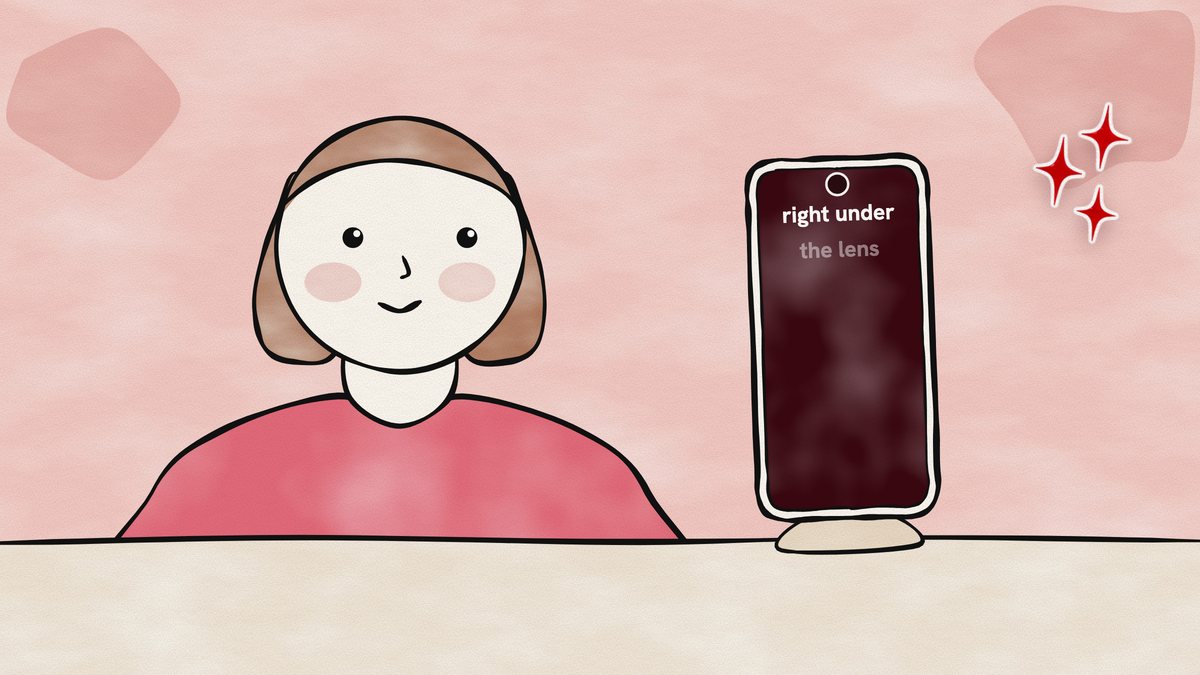
How to use a teleprompter on your phone
Where to put the text, how big to make it, how fast to scroll, and when voice-follow beats a fixed speed, for TikTok, Reels and YouTube.
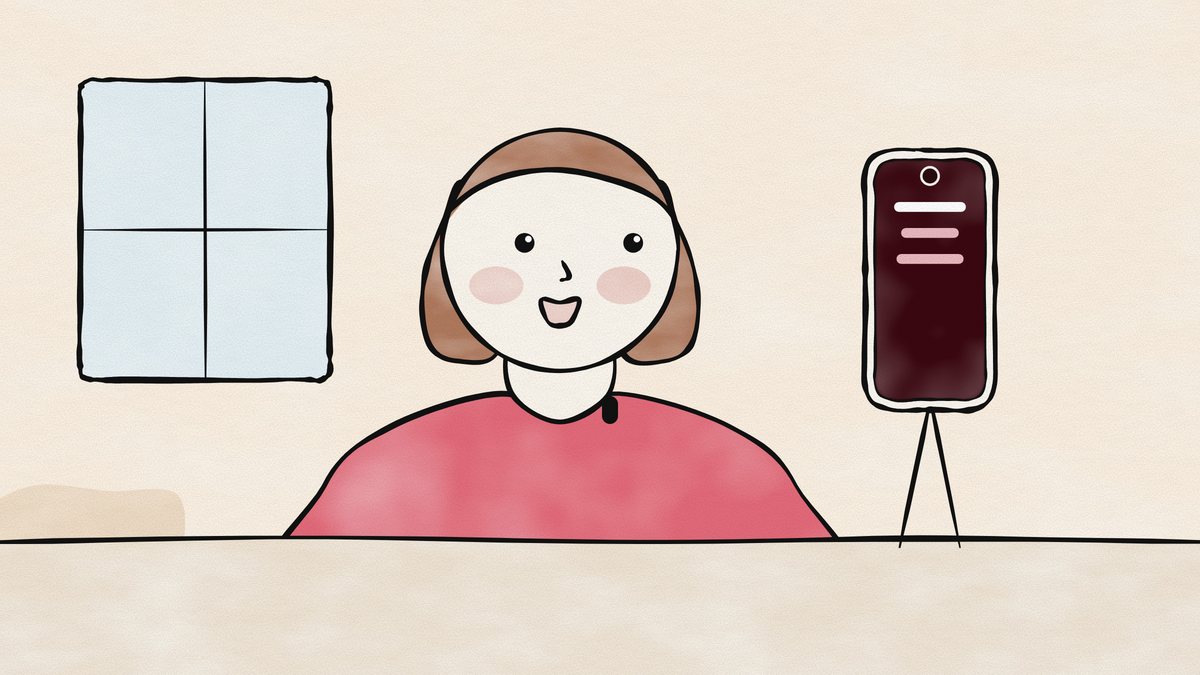
Talking head video setup on an iPhone
Sound first, then phone height, distance, window light, framing and takes. A simple talking head setup with the research that exists behind it.