
How to memorize a script fast

In this article
Students who read a passage four times in a row managed to read it through about 14 times in total. Students who read it once and then spent the rest of the time writing down what they could remember got through it only about 3 times 1. A week later, the second group remembered more.
The study, at Washington University in St. Louis, gave 180 undergraduates a short prose passage and four 5-minute sessions to learn it 1. One group studied it in all four sessions. One studied it three times and then wrote out what they could recall. One studied it once and recalled it three times. Five minutes later, the readers were ahead: 83% recalled against 71% for the recallers. A week later the order flipped: 40% for the readers, 56% for the one-test group and 61% for the three-test group 1.
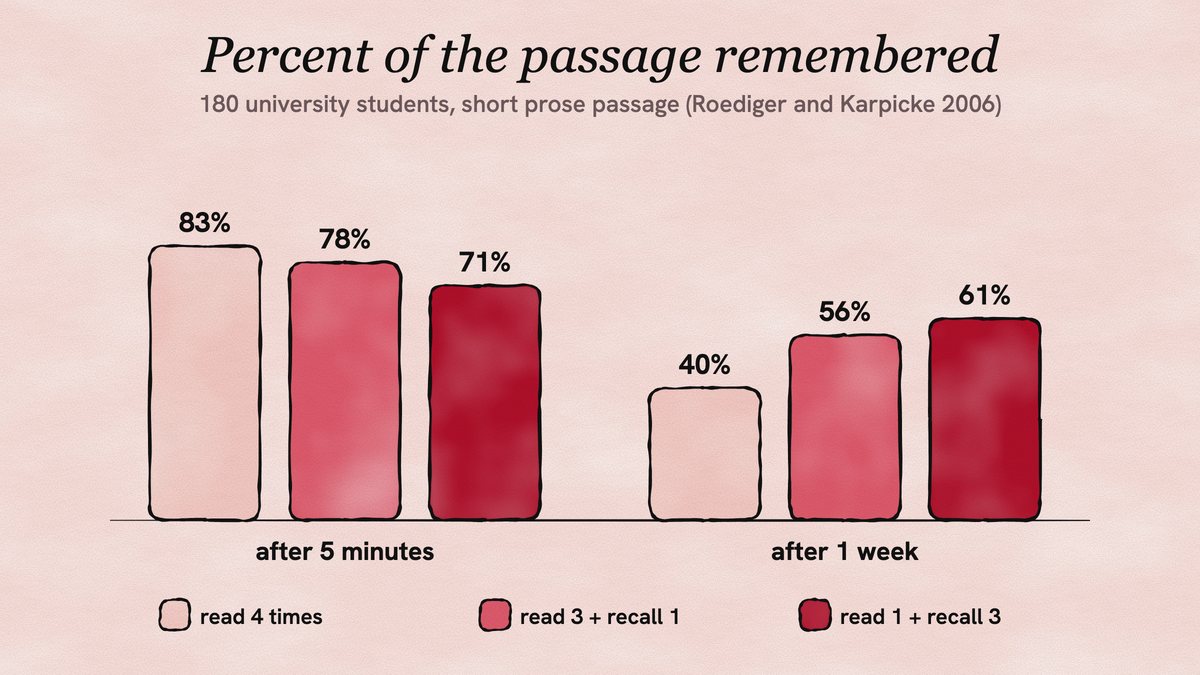
The rereaders were also the most confident that they would remember the passage in a week 1. Rereading feels like learning because the words look familiar. That feeling is a poor guide.
What is the fastest way to memorize a script?
The fastest reliable method is to practise pulling the words out of your head, not putting them in again. Psychologists call this retrieval practice, or the testing effect. In an earlier experiment in the same paper, with 120 students, a single recall attempt beat a second reading after two days (68% against 54%) and after a week (56% against 42%) 1.
For a script, that means you cover the page and say it. Check what you missed, then cover it again. It feels harder and slower than reading, and that is the point.
One caution about these numbers. The students were scored on the ideas they recalled, not exact wording 1. A script you must deliver word for word is a stricter test, and we found nothing that measured exactly that with this method.
Is it better to cram or to spread out practice?
Spreading practice out works better than cramming it into one block. A large review counted 839 tests of spaced practice, from 317 experiments in 184 articles 2. It found that the best gap between study sessions grows with how long you need to remember the material 2. By our reading, for a talk next week, a gap of a day or so between sessions makes more sense than an hour.
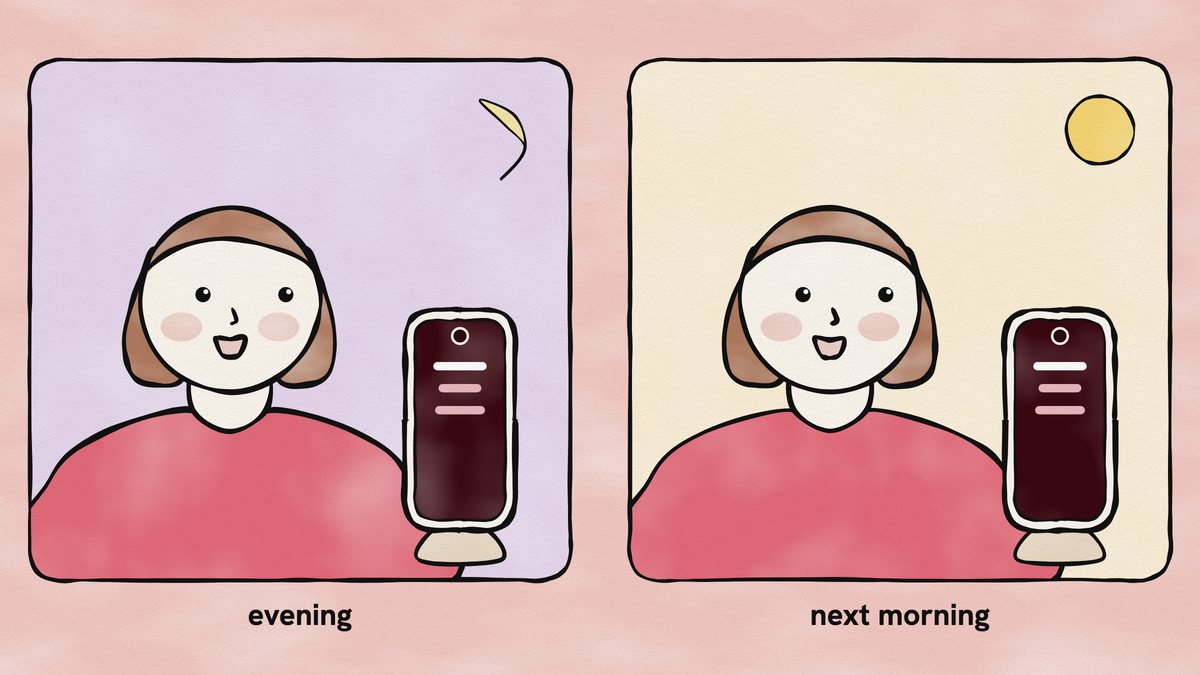
Sleep may do some of the work for you. In a study from Lyon, France, 40 people learned foreign words to a perfect score and relearned them 12 hours later. Half learned in the morning and relearned that evening. The other half learned in the evening, slept, and relearned the next morning. Sleeping between the two sessions cut the practice needed by half and gave much better long-term memory, tested a week and six months later 3. That was vocabulary, not a script, but the lesson carries: a run-through tonight and another tomorrow morning beats two runs in one afternoon.
How do actors memorize lines so fast?
Actors work on what the lines mean, and the words follow. Earlier research found that actors reach word-for-word recall with a meaning-based strategy, one that usually only gives you the gist 4. When six actors talked through their thinking while studying a new script, they paid close attention to the exact wording and even punctuation, because they needed it to understand the character 4.
It works. Professional actors in one study delivered their scripts with about 98% accuracy during performances. Three months after the final show, having learned other roles since, they still recalled about 90% of the text word for word or very close to it 5.
Movement helps too. Nonactors who read a script aloud while moving as a director told them remembered more than people who only spoke it, and more than people who simply set out to memorize it. They also remembered the lines they had moved on better than the lines they had stood still for 6.
Can you memorize a script in a day, or in 30 minutes?
You can learn a short script in a day, and the research suggests how to spend that day. Split your practice into several sessions with breaks 2, recite from memory rather than rereading 1, and if you have a night, sleep on it before your last run 3.
Thirty minutes is a different job. We found no research on how much script a person can learn in half an hour. Our honest advice is to learn the opening and the closing lines by heart, know the order of your points, and keep the rest in front of you.
When should you not memorize a script word for word?
Memorizing every word is often the wrong goal. In a survey of 499 adults in Winnipeg, the mind going blank (74%) was among the most common worries people reported about public speaking 7. If you are filming, there is little reason to carry that risk.
Learn it word for word when the exact wording matters and you will be on stage without notes, or when you want to move around freely. Use bullet points when you know the subject well and only need the order. Use a teleprompter when the wording matters and the deadline is today, as with a sales video, an announcement or a short reel with a carefully timed hook. That is the reason we built YapPlease: the script scrolls over the camera view, close to the lens, and can follow your voice line by line.
How do you memorize a script step by step?
These steps combine the studies above with our own advice where noted.
- Read it once for meaning. Ask why each line is there and what you want the viewer to feel, as actors do 4.
- Break it into chunks. Two or three sentences each. This is our advice.
- Cover and recite. Say a chunk from memory, then check it. Repeat until it comes out clean 1.
- Add movement. Gesture, walk, or practise in the spot where you'll film 6.
- Space it. Do several short sessions, not one long one 2.
- Sleep on it. Run it in the evening and again the next morning 3.
- Do a full run on camera. Recording adds pressure, so rehearse with it. This is our advice.
Common questions
How can I memorize a script in one day?
Split the day into several short sessions and spend them reciting from memory rather than rereading. In one study of 180 students, those who recalled a passage three times remembered 61% after a week, against 40% for those who reread it 1. If you have the night before, sleeping between two sessions halved the practice needed in a study of 40 people learning foreign words 3.
Is it better to read a script over and over or test yourself?
Test yourself. Rereading gave slightly better recall after five minutes (83% against 71%), but recalling from memory gave better recall a week later (61% against 40%) among 180 university students 1. The rereaders also felt more confident, so the feeling of knowing it can mislead you 1.
How do actors remember so many lines?
They study what the lines mean, paying close attention to the exact wording to understand the character 4. Professional actors in one study delivered their scripts with about 98% accuracy and still recalled about 90% three months after the last show 5. Moving while learning also helped nonactors remember lines 6.
Should I memorize my presentation word for word?
Usually not. Fear of your mind going blank is very common 7, and memorizing every word raises the stakes if you lose your place. Learn your opening, your closing and the order of your points, and use notes or a teleprompter for the rest.
Sources
- Roediger HL, Karpicke JD (2006). Test-enhanced learning: taking memory tests improves long-term retention. Psychological Science 17(3):249-255. PubMed
- Cepeda NJ, Pashler H, Vul E, Wixted JT, Rohrer D (2006). Distributed practice in verbal recall tasks: a review and quantitative synthesis. Psychological Bulletin 132(3):354-380. PubMed
- Mazza S, Gerbier E, Gustin MP, Kasikci Z, Koenig O, Toppino TC, Magnin M (2016). Relearn faster and retain longer. Psychological Science 27(10):1321-1330. PubMed
- Noice H, Noice T (1996). Two approaches to learning a theatrical script. Memory 4(1):1-17. PubMed
- Noice H, Noice T (1999). Long-term retention of theatrical roles. Memory 7(3):357-382. PubMed
- Noice H, Noice T (2001). Learning dialogue with and without movement. Memory & Cognition 29(6):820-827. PubMed
- Stein MB, Walker JR, Forde DR (1996). Public-speaking fears in a community sample: prevalence, impact on functioning, and diagnostic classification. Archives of General Psychiatry 53(2):169-174. PubMed
Keep reading
How to use a teleprompter on your phone
Where to put the text, how big to make it, how fast to scroll, and when voice-follow beats a fixed speed, for TikTok, Reels and YouTube.
How to read a script without looking like you're reading
Viewers are sharp at spotting where eyes point, yet loose about what counts as eye contact. Use that: short lines, text near the lens, calm pace.
How to sound natural reading a script
Listeners can hear reading even with the words filtered out. What small speech studies show about why scripts sound read, and how to fix yours.