
How to read a script without looking like you're reading
In this article
Your viewers are better at reading your eyes than you might like. In one lab test, people judging where a live person was looking could pick up a difference of about 30 seconds of arc 1. That is a tiny fraction of a single degree.
A later paper puts this in plainer terms. At a distance of 1 metre, an observer can see a gaze shift from the inner to the outer corner of one eye 2.
So it is fair to worry that the camera will catch you reading. The good news is that people apply a much looser rule to one question: "Is this person looking at me?"
Can viewers tell you are reading from a script?
People are fussy about where a gaze points and generous about eye contact. The 30 seconds of arc came from judging whether someone looked left or right of a target point in space 1. Deciding whether someone is looking at you works differently.
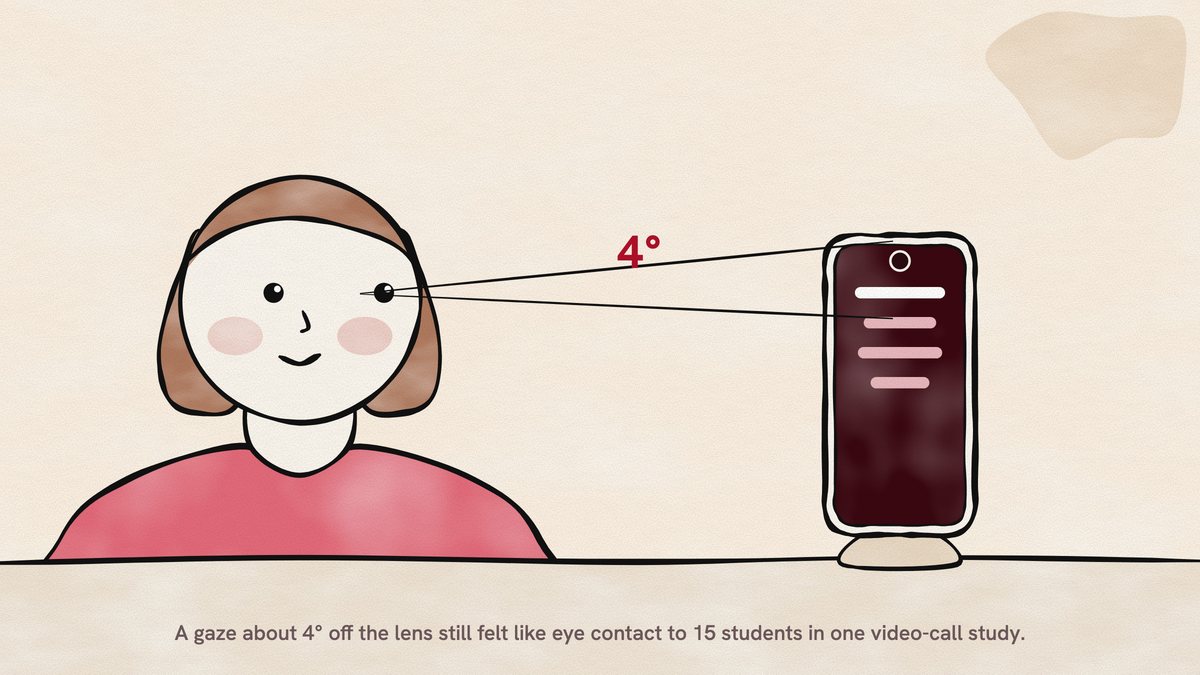
In a video-call setup, 15 students looked at a person on screen whose eyes were turned slightly up or down from the camera. They still felt looked at across a band about 4 degrees either side of the best direction 2. A separate experiment found that when the eyes are hard to see, people lean towards feeling looked at. All participants saw noisy eyes as aimed more towards themselves 3.
Put together, these studies suggest a simple goal. Viewers can spot big swings of the eyes, and small movements close to the lens are likely to pass as eye contact. We found no experiment that tested whether viewers can spot someone reading a prompter, so treat this as a reasonable reading of gaze research and not as a direct test.
How far do your eyes move when you read a script?
Your eyes jump along a line by a number of letters, whatever size those letters are. That is the finding in the title of a 1981 study: saccade size in reading depends on character spaces and not visual angle 4. A saccade is one quick jump of the eyes.
By our reading, this means the width of each line on the screen sets how far your eyes swing. Long lines across a wide screen mean big sweeps that the camera can see. Short lines in a narrow column near the lens mean small ones.
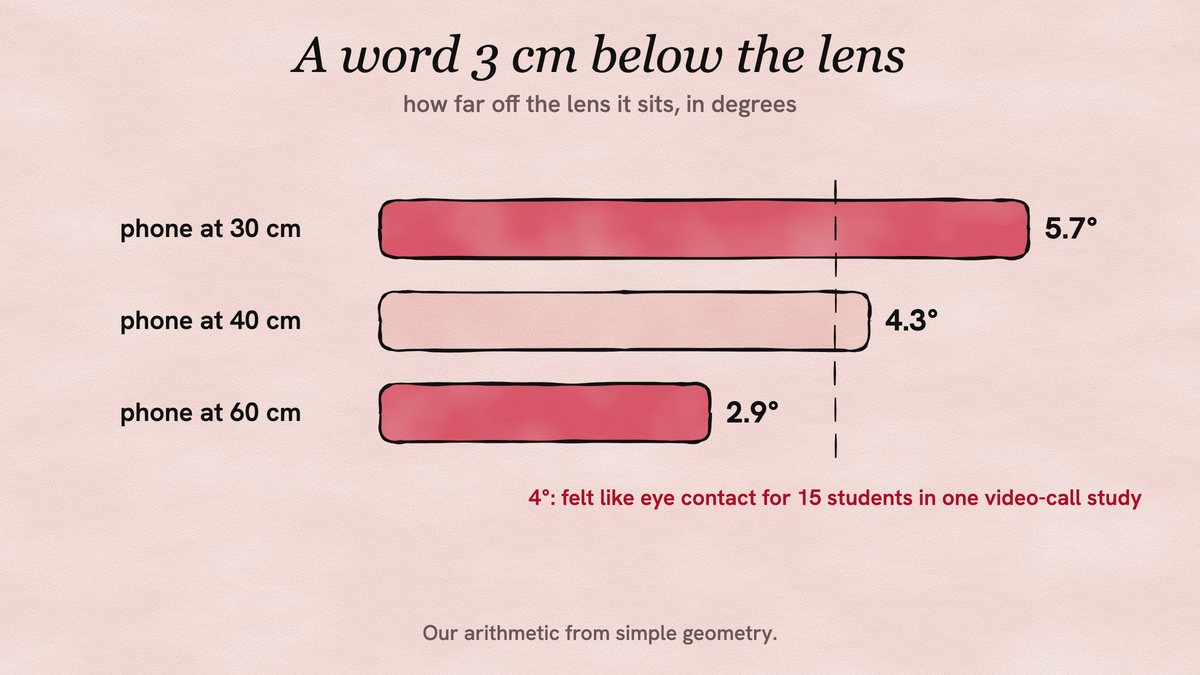
Distance helps too. Here is our arithmetic for a word 3 cm to the side of, or below, the lens:
- Phone 30 cm away: about 5.7 degrees off the lens.
- Phone 40 cm away: about 4.3 degrees.
- Phone 60 cm away: about 2.9 degrees.
The angle is the arctangent of 3 cm divided by the distance. At 60 cm, a line that runs 3 cm either side of the lens stays inside the roughly 4 degree band from the video-call study, which was measured for up-and-down gaze 2. At 30 cm it doesn't.
Why does reading a script sound like reading?
Read speech has a different sound from free speech, and listeners respond to the difference. In one experiment, two men first spoke freely to an interviewer, then read their own transcribed words aloud. Thirty-two listeners heard matching sentences and judged which were spontaneous and which were read 5.
The read versions had a lower articulation rate, more variation in pitch and loudness, and less vowel reduction 5. Vowel reduction is the way "to" turns into "tuh" in relaxed talk. No single feature gave the game away on its own, and both speakers and listeners varied enormously 5.
A much larger study points the same way. Each of 192 American speakers, from children to older adults, read sentences and also talked freely. Articulation rate in reading was slower than in speaking 6.
So the robotic sound has a cause you can work on. Read speech tends to be slower and more carefully pronounced than the way you talk. The listening study is small and old, and neither study looked at video, so take this as a pattern to listen for in your own takes.
How fast should you read a script?
Most adults read aloud at around 183 words per minute. That is the average across 77 studies with 5,965 participants, in several languages that use the Latin alphabet 7.
Pauses are your friend here. In a study of how listeners judge speaking rate, the speed of the words themselves weighed much more than the number and length of pauses 8. By our reading, that means a pause at a full stop costs you little in perceived pace. Rushing the words is what makes you sound hurried.
How do you break up a script so it sounds natural?
This part is practical advice from filming, not a finding from the studies above. Write the script the way you talk, then break it into short lines that each hold one idea. A line of four to eight words is easy to take in at a glance, keeps your eyes close to the lens and gives you a natural place to breathe.
Use contractions and short words. Put a line break where you want to pause, so your eyes and your voice stop together.
What doesn't the research show?
We found no experiment that filmed people reading a phone prompter and asked viewers if they noticed. The gaze studies showed pictures or computer-made faces on screens 23, and the precise 30 seconds of arc came from a different kind of judgement 1. The speech studies compared reading with free talk and didn't test any trick for sounding natural 56. Everything here combines those findings with simple geometry, and your own test footage is the final judge.
Steps to try today
- Put the phone at arm's length or farther, at eye height.
- Narrow the text to a short column right under the lens.
- Rewrite your script in short lines of one idea each.
- Read it once aloud before filming, then film a 30-second test.
- Watch the test with the sound off. If your eyes swing, move the phone back or shorten the lines.
- Watch again with the sound on. If it sounds read, slow the words slightly and lengthen the pauses.
A small tool can help with steps 1 and 2. YapPlease, the teleprompter we built, puts the script right under the lens and can scroll along with your voice, waiting when you pause.
Common questions
Can people tell if you are reading a teleprompter?
People can be very precise about where a gaze points: one lab study measured a threshold of about 30 seconds of arc 1. Feeling looked at is looser. In a video-call study, 15 students still felt looked at when the eyes were about 4 degrees off the best direction 2. We found no experiment that tested teleprompter reading directly, so keep your words close to the lens and check your own footage.
How do you read a teleprompter without moving your eyes?
You can't avoid eye movement completely, because your eyes jump along a line by a number of letters, whatever their size 4. You can make each jump smaller in degrees. Use a narrow column of text right under the lens and move the phone farther away. By our arithmetic, a word 3 cm from the lens sits about 4.3 degrees off at 40 cm and 2.9 degrees off at 60 cm.
How do you read a script without sounding like a robot?
Read speech tends to be slower than free talk, with less of the relaxed vowel shortening of everyday speech, and listeners use those differences when judging what was read 56. Write in short spoken sentences, use contractions and pause at line breaks. Pauses cost little in how fast you seem to speak, because listeners judge pace mainly by how fast the words themselves come 8.
What is a natural speed for reading a script aloud?
Across 77 studies with 5,965 participants, the average reading-aloud rate was 183 words per minute 7. Treat it as a starting point and adjust after watching a test take.
Sources
- Symons LA, Lee K, Cedrone CC, Nishimura M (2004). What are you looking at? Acuity for triadic eye gaze. Journal of General Psychology 131(4):451-469. PubMed
- Horstmann G, Linke L (2022). Perception of direct gaze in a video-conference setting: the effects of position and size. Cognitive Research: Principles and Implications 7(1):67. PubMed
- Mareschal I, Calder AJ, Clifford CW (2013). Humans have an expectation that gaze is directed toward them. Current Biology 23(8):717-721. PubMed
- Morrison RE, Rayner K (1981). Saccade size in reading depends upon character spaces and not visual angle. Perception & Psychophysics 30(4):395-396. PubMed
- Laan GPM (1997). The contribution of intonation, segmental durations, and spectral features to the perception of a spontaneous and a read speaking style. Speech Communication 22(1):43-65. DOI 10.1016/S0167-6393(97)00012-5. Publisher
- Jacewicz E, Fox RA, Wei L (2010). Between-speaker and within-speaker variation in speech tempo of American English. Journal of the Acoustical Society of America 128(2):839-850. PubMed
- Brysbaert M (2019). How many words do we read per minute? A review and meta-analysis of reading rate. Journal of Memory and Language 109:104047. DOI
- Grosjean F, Lane H (1976). How the listener integrates the components of speaking rate. Journal of Experimental Psychology: Human Perception and Performance 2(4):538-543. PubMed
Keep reading
How to look at the camera while reading a script
Gaze studies say eye contact survives a few degrees off the lens. Here is how that turns into centimetres on your phone, and where to put the words.
How to sound natural reading a script
Listeners can hear reading even with the words filtered out. What small speech studies show about why scripts sound read, and how to fix yours.
How to use a teleprompter on your phone
Where to put the text, how big to make it, how fast to scroll, and when voice-follow beats a fixed speed, for TikTok, Reels and YouTube.