
How to sound natural reading a script
In this article
In 1982, three researchers recorded four teachers reading and telling well-known stories to preschool children. They cut the tapes into 10-second clips and ran half of them through a filter that removed the words and kept only the melody, rhythm and voice 1.
Two groups of 11 adults listened and judged each clip. With or without the words, they could tell reading from telling. They did better when they could hear the words 1.
So a script gives itself away before anyone hears what you are saying. The good news is that the giveaway lives in how you say it, and you can change that.
Can people tell when you're reading a script?
Yes, most of the time, even when the reading is fluent. In a study from Utrecht, one man was recorded in a 90-minute interview and later read large parts of a transcript aloud. Ten listeners heard 48 fluent spontaneous clips and the 48 matching read ones, and classified them correctly 79% of the time 2. In a second set, five men explained how to build a cardboard house front and then read their own instructions back. Twenty-one listeners got 77% right 2.
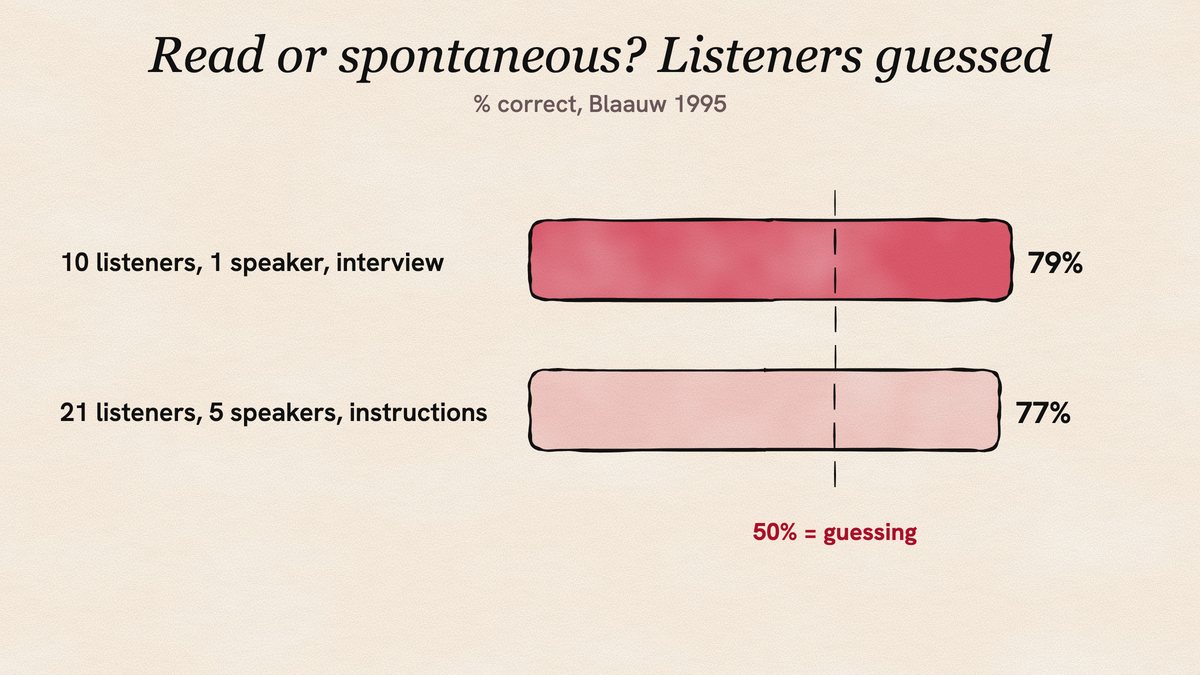
The words were identical in each pair. Only the delivery differed.
A Dutch study went a step further. Two men talked about themselves and then read their own transcribed words. Eleven listeners classified fluent, identically worded pairs correctly 75.4% of the time 3. When the researchers swapped the pitch, timing and loudness between the two versions by computer, the judgement turned round, and listeners now leaned towards the wrong answer 3. Those results were preliminary, from only 11 listeners 3.
Why does reading a script sound robotic?
Read speech tends to settle into one steady, middle-of-the-road style. That is the main finding of the Utrecht work. Spontaneous speech can drift in any direction: faster or slower, flatter or more animated, depending on the moment. Read speech stays near the middle 2.
The numbers show it. In the interview, spontaneous speech was faster than the reading (7.1 syllables a second against 6.3). In the instructions, it was slower (5.2 against 5.8) 2. Pitch range reversed too 2. The two read versions sat close together, between the spontaneous extremes 2.
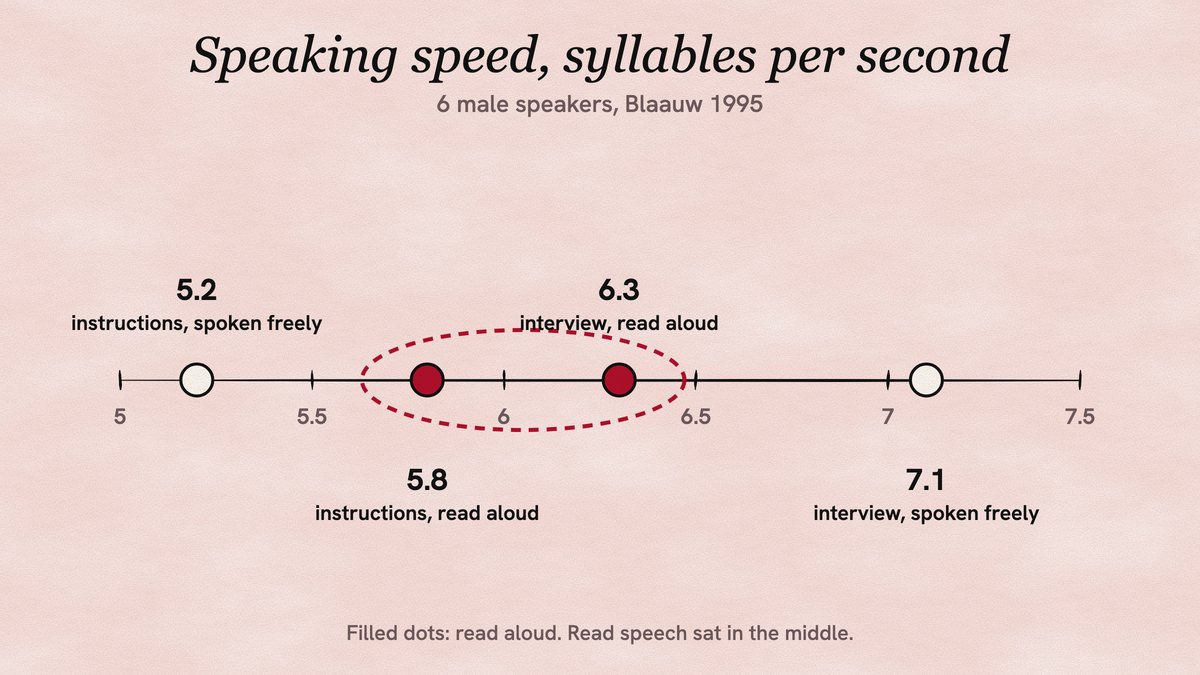
That rules out a single trick like "slow down" or "speed up". By our reading, the fix is variety: let your pace and pitch move with what you mean, the way they do when you talk.
The teachers' study adds two details. Reading was faster and freer of hesitations than telling, which the authors put down to storytelling being a creative task 1. And a literary habit gave reading away: putting "she said" after a quote is common in writing and almost never used when telling a story 1.
Does it help to write the way you talk?
It helps, but it is not enough on its own. In the Dutch study, the speakers read their own words, transcribed from what they had just said, and listeners still told the two versions apart 75.4% of the time 3. The authors also note that by picking only fluent, identically worded sentences, they removed cues from grammar, word choice and pauses, which are probably very important for telling the styles apart 3.
So two things matter. Write lines you would actually say, and then practise saying them with life. The writing tips below are our advice, and we found nothing that tested them on video scripts.
- Short sentences. One idea each. Long sentences push you into a flat reading rhythm.
- Contractions. "You'll" and "don't", not "you will" and "do not", unless you want the stress.
- Speaker tags first. Write "She said, it's fine" rather than "It's fine, she said" 1.
- Words you use. If you'd never say "utilize" to a friend, don't put it in the script.
How do you practise reading a script naturally?
Practise the delivery, not only the words. These steps are our advice, built on the studies above.
- Tell it first. Before you look at the script, explain the idea out loud to an imaginary friend. Notice where your voice rises and where you pause.
- Read it aloud once, slowly. Any line you stumble on twice needs rewriting, not more practice.
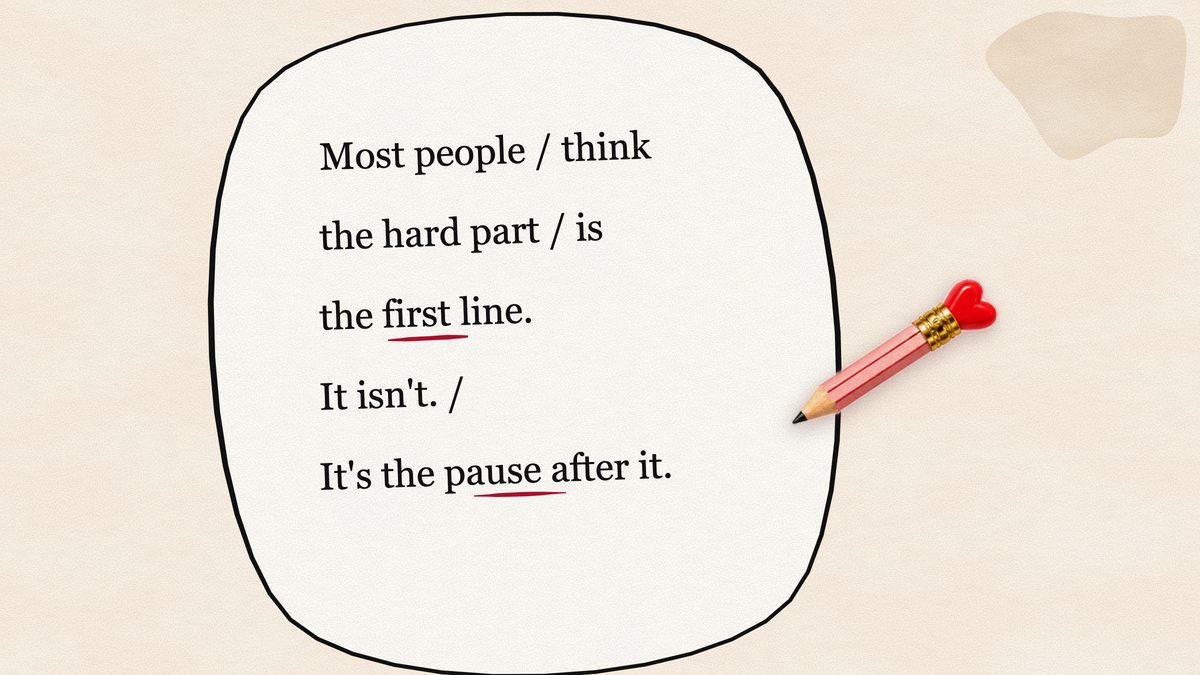
- Mark your pauses. Draw a slash where you would breathe or let a point land. Natural speech moves away from the steady read style 2, and pauses are an easy place to start.
- Underline one word per sentence. Give it the stress you'd give it in conversation.
- Break the middle. If every sentence comes out at the same speed and pitch, you are in the steady read style 2. Speed up through an aside, slow down for the point.
- Record a test take and listen without watching. Would a friend think you were reading? Fix the lines that sound read and try again.
A teleprompter can help, as long as it doesn't set your pace for you. That is why YapPlease can follow your voice line by line and wait when you pause, so the pauses stay yours.
What doesn't the research show?
This evidence is old and small. The studies we found used a handful of speakers, most of them men, in papers published between 1982 and 1995 1 2 3. They compared reading with talking, not reading well with reading badly. We found nothing that tested whether marking pauses or rewriting lines makes a video sound less read. The steps above are reasonable practice, not proven methods.
Common questions
How do you read a script without sounding like a robot?
Vary your delivery. Read speech tends to sit in a steady middle of pace and pitch, while spontaneous speech moves away from it in either direction 2. Mark pauses, stress one word per sentence, and let your speed change with the meaning.
Can people tell if you are reading?
Usually. In a study from Utrecht, 10 listeners classified fluent read and spontaneous sentences correctly 79% of the time, and 21 listeners scored 77% on a second set 2. In a 1982 study, adults could tell teachers reading stories from telling them even when a filter removed the words 1.
Why does my voice sound flat when I read?
Reading tends to pull speech toward a steady, average style. In the Utrecht study, the two read versions had similar pace and pitch, while spontaneous speech moved to either side of them 2. Even when two men read their own transcribed words, 11 listeners in a small Dutch study told the read and spoken versions apart 75.4% of the time 3.
Should I speak faster to sound more natural?
Not as a rule. Spontaneous speech was faster than reading in one set of recordings (7.1 against 6.3 syllables a second) and slower in another (5.2 against 5.8) 2. Change your speed with what you're saying instead of picking a single new speed.
Sources
- Levin H, Schaffer CA, Snow CE (1982). The prosodic and paralinguistic features of reading and telling stories. Language and Speech 25(1):43-54. Not indexed in PubMed. DOI
- Blaauw E (1995). On the perceptual classification of spontaneous and read speech. Proceedings of the 13th International Congress of Phonetic Sciences, Stockholm, Vol. 3:254-257. Not indexed in PubMed. PDF
- Laan GPM, van Bergem DR (1993). The contribution of pitch contour, phoneme durations and spectral features to the character of spontaneous and read aloud speech. Proceedings of Eurospeech 1993, Berlin, 569-572. Not indexed in PubMed. DOI
Keep reading
How to read a script without looking like you're reading
Viewers are sharp at spotting where eyes point, yet loose about what counts as eye contact. Use that: short lines, text near the lens, calm pace.
How to write a script for Reels and TikTok
A fill-in reel script template, a 30-second example, current length limits from Instagram and TikTok, and how many words fit in 15 to 90 seconds.
How to memorize a script fast
Rereading feels productive but fades within a week. Memory research points to reciting from memory, spacing and sleep. Here is how to use them.