
How to be confident on camera
In this article
Forty Cornell students took turns giving a three-minute speech they had no time to prepare. Afterwards each one rated, on a scale from 0 to 10, how nervous they had felt, how nervous they thought they had looked, and how nervous their partner had looked 1.
The speakers felt nervous, at 5.95 on average. They believed they had looked even more nervous, at 6.55. Their partners, who had just watched them, put it at 5.25 1. Twenty-seven of the 40 thought they had looked more nervous than the other person 1. The researchers call this the illusion of transparency. You feel your nerves from the inside and assume they show on the outside.
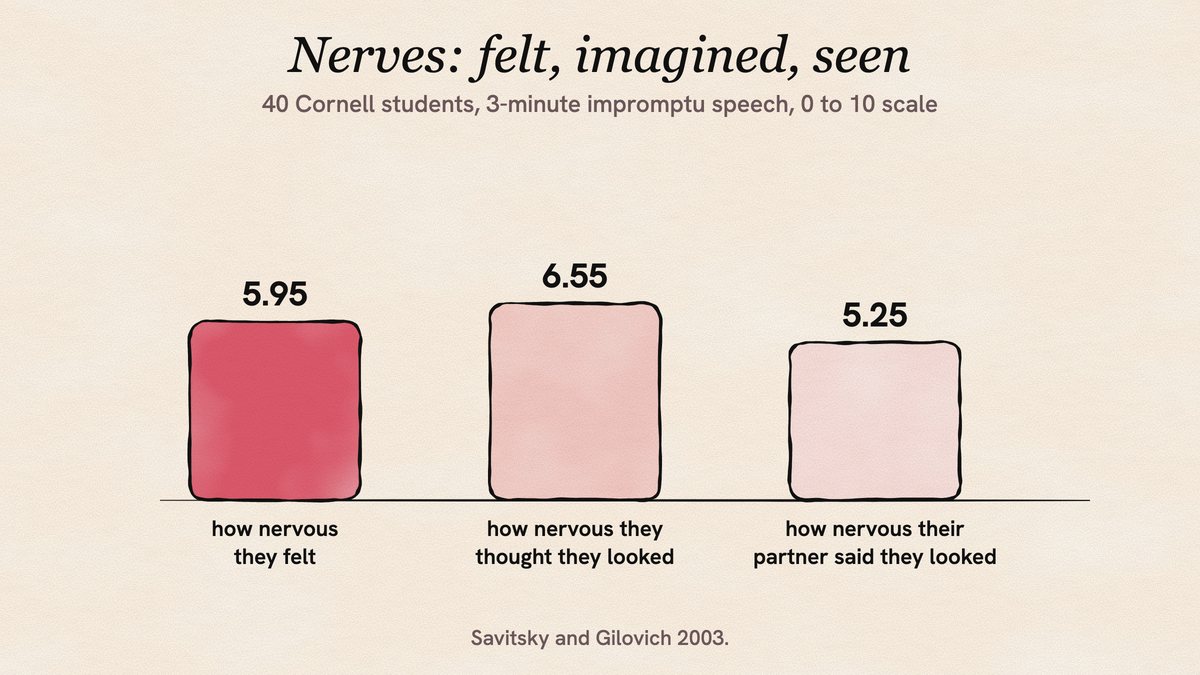
That gap is the best news in this post. The camera sees less of your fear than you do.
Why is it so hard to feel confident on camera?
Fear of speaking is very common. In a phone survey of 499 adults in Winnipeg, Canada, one third said they had excessive anxiety when speaking to a large audience 2. The anxious thoughts they reported included trembling or showing other signs of anxiety (80%) and their mind going blank (74%) 2.
Among 815 college students in a communication course, public speaking was picked as a fear more often than any other item on the list, including death. When they had to name a single top fear, death came first 3.
A camera adds its own twist. In a 2026 study, people with raised social anxiety gave a short talk on a video call. Those who had their camera on but could not see an audience judged their own performance as worse, and dwelt on it more afterwards, than people in the other set-ups 4. That set-up is close to filming yourself with a phone: you see a lens, maybe your own face, and no face nodding back. The study looked at video calls, so treat the link to filming as our guess.
Do you look as nervous as you feel?
You almost certainly look calmer than you feel. The Cornell team ran a second study with 77 student speakers. Some were told, before they spoke, that audiences can't pick up on a speaker's anxiety as well as the speaker expects 1.
That one paragraph changed how they came across. On a 1 to 7 scale, observers rated the informed speakers as more composed (4.65, against 3.90 and 3.94 in the other two groups) and their speeches as better (4.23, against 3.50 and 3.62) 1. A plain reassurance to stop worrying did not have the same effect 1.
Should you calm down or get excited?
Try telling yourself you are excited. In a series of studies at Harvard, Alison Wood Brooks found that most people believe calming down is the best way to handle nerves before a performance 5. Yet people who reframed their nerves as excitement felt more excited and performed better than people who tried to calm down 5.
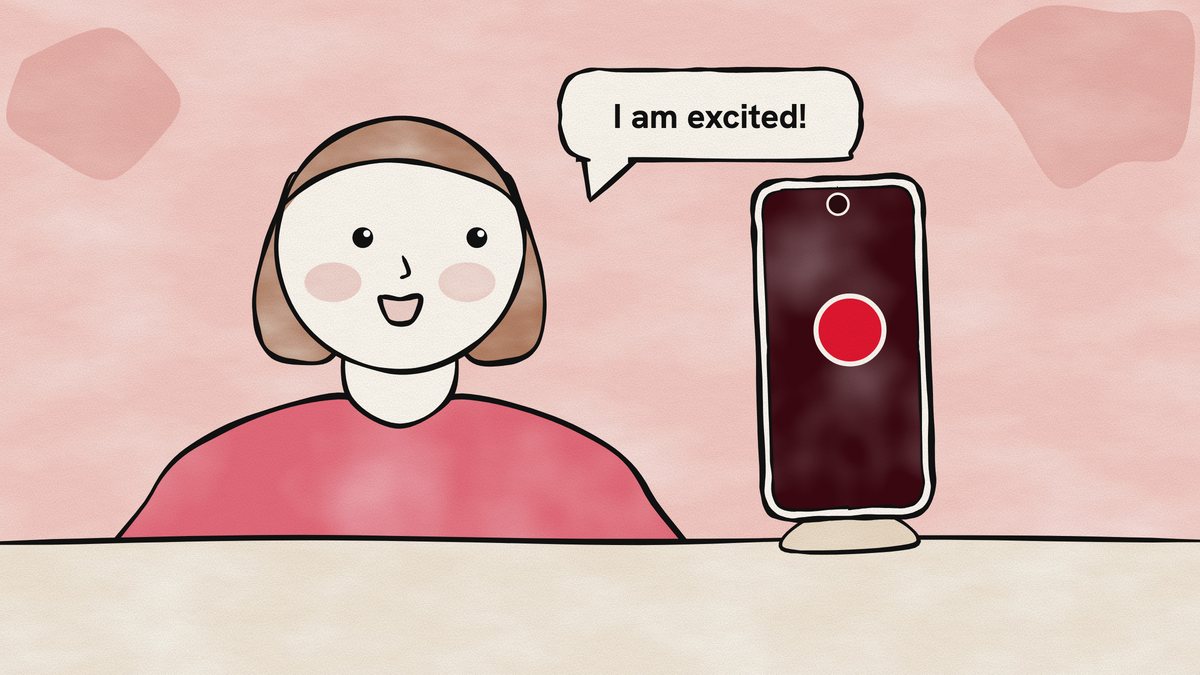
In one of those studies, 140 people prepared a persuasive speech, which was videotaped and, they were told, would be judged by a committee. Just before speaking, they said either "I am excited" or "I am calm". The excited group gave longer speeches, and independent raters judged them more persuasive, competent and relaxed 6. In a karaoke version with 113 people, those who said they were excited scored 80% on the game's pitch, rhythm and volume rating, against 53% for those who said they were anxious 6.
The idea behind it is simple. Anxiety and excitement are both states of high arousal, so relabelling the feeling may be easier than switching it off, as Brooks put it in the press release 6.
Does practice make you more confident on camera?
Practice helps, though most of the evidence comes from structured programmes. A 2019 review pooled 30 randomized trials with 1,355 participants, mostly testing programmes based on facing the fear and changing how people think about it. Overall the programmes clearly reduced fear of public speaking, and people in the cognitive and behavioural programmes kept improving after they ended 7. People's own reports improved more than their measured body signals and behaviour, and there were some signs of publication bias 7.
Repetition within a single session may matter too. In a small pilot study, 19 adults gave three short speeches in a row to a virtual audience. Distress rose during the second speech, and the authors concluded that all three consecutive speeches were needed before it started to settle 8. That is a tiny study, so take the lesson loosely: if the second take feels worse, keep going to the third.
Should you watch your own takes?
Watching yourself back can help, as long as you watch the right way. Socially anxious people tend to rate their own performance as worse than observers do. After watching a video of themselves, their ratings moved closer to what observers saw 9.
One study added a simple preparation. Before watching, people predicted in detail what they would see, pictured themselves giving the speech, and then watched the video as though they were watching a stranger. Those people rated their performance higher than people who watched without preparing 10.
What can you try before your next video?
These steps borrow from the studies above. The ones that go beyond the research are our own advice.
- Remind yourself of the gap. Your nerves show less than you think 1. Say it to yourself, or reread the first lines of this post.
- Say "I am excited" out loud right before you press record 5.
- Plan for three takes. Treat the first two as warm-ups and expect the second to feel shaky 8.
- Hide your own face if you can. Seeing yourself while you talk, with no audience in view, may push you to judge yourself harshly 4. Look at the lens or your script instead.
- Watch back like a stranger. Guess first what you will see, then watch as if it were someone else's video 10.
- Keep your words close. Fear of your mind going blank is common 2. A short script or notes near the lens takes that worry off the table.
That last step is why we made YapPlease. It scrolls your script over the camera view, close to the lens, so you can look at the viewer and still know your next line.
What doesn't the research show?
Many of these studies put college students in front of live listeners in a lab. We found little research on people filming themselves alone with a phone, and the closest study looked at video calls 4. The "I am excited" details come from the publisher's press release, because we could not open the full paper 6.
Common questions
How do I look more confident on camera?
Start by trusting that you already look calmer than you feel. Forty Cornell students rated how nervous they looked at 6.55 out of 10, while the people watching rated them at 5.25 1. In a second study, speakers who were told about this gap were rated by observers as more composed and as giving better speeches 1.
How do I get comfortable talking to the camera?
Record more than once in a row. In a pilot study of 19 adults giving three short speeches to a virtual audience, distress went up in the second speech and began to settle only across all three 8. Structured practice programmes reduced fear of public speaking across 30 randomized trials 7.
Should I try to calm down before filming?
Try getting excited instead. In studies at Harvard, people who reframed their nerves as excitement felt more excited and performed better than people who tried to calm down 5. In one study with 140 people, those who said "I am excited" before a videotaped speech were rated as more persuasive, competent and relaxed 6.
Is it normal to be scared of talking on camera?
It is very common. In a survey of 499 adults in Winnipeg, one third reported excessive anxiety when speaking to a large audience 2. Among 815 college students, public speaking was chosen as a fear more often than any other item on the list, including death 3.
Sources
- Savitsky K, Gilovich T (2003). The illusion of transparency and the alleviation of speech anxiety. Journal of Experimental Social Psychology 39(6):618-625. DOI 10.1016/S0022-1031(03)00056-8. Not indexed in PubMed. Journal page
- Stein MB, Walker JR, Forde DR (1996). Public-speaking fears in a community sample: prevalence, impact on functioning, and diagnostic classification. Archives of General Psychiatry 53(2):169-174. PubMed
- Dwyer KK, Davidson MM (2012). Is public speaking really more feared than death? Communication Research Reports 29(2):99-107. Not indexed in PubMed. DOI
- Özhan N, Graf EW, Garner M (2026). Social anxiety in online social interactions: examining the effects of self and audience images on anxiety, self-awareness and performance evaluations. Journal of Anxiety Disorders 118:103111. PubMed
- Brooks AW (2014). Get excited: reappraising pre-performance anxiety as excitement. Journal of Experimental Psychology: General 143(3):1144-1158. PubMed
- American Psychological Association (2013). Getting excited helps with performance anxiety more than trying to calm down, study finds. Press release on Brooks 2014, read 2026-11-20. EurekAlert
- Ebrahimi OV, Pallesen S, Kenter RMF, Nordgreen T (2019). Psychological interventions for the fear of public speaking: a meta-analysis. Frontiers in Psychology 10:488. PubMed
- Takac M, Collett J, Blom KJ, Conduit R, Rehm I, De Foe A (2019). Public speaking anxiety decreases within repeated virtual reality training sessions. PLoS One 14(5):e0216288. PubMed
- Rapee RM, Hayman K (1996). The effects of video feedback on the self-evaluation of performance in socially anxious subjects. Behaviour Research and Therapy 34(4):315-322. PubMed
- Harvey AG, Clark DM, Ehlers A, Rapee RM (2000). Social anxiety and self-impression: cognitive preparation enhances the beneficial effects of video feedback following a stressful social task. Behaviour Research and Therapy 38(12):1183-1192. PubMed
Keep reading
How to look at the camera while reading a script
Gaze studies say eye contact survives a few degrees off the lens. Here is how that turns into centimetres on your phone, and where to put the words.
How to stop saying um
Um is a word your brain plans on purpose. Here is what the research says it signals, what it costs you, and the few steps that cut it in small studies.
Why do I sound weird on video?
You hear your own voice through your skull as well as the air, and a phone mic hears only the air. What the research says, and how to get used to it.