
How many words is a 60-second script?
In this article
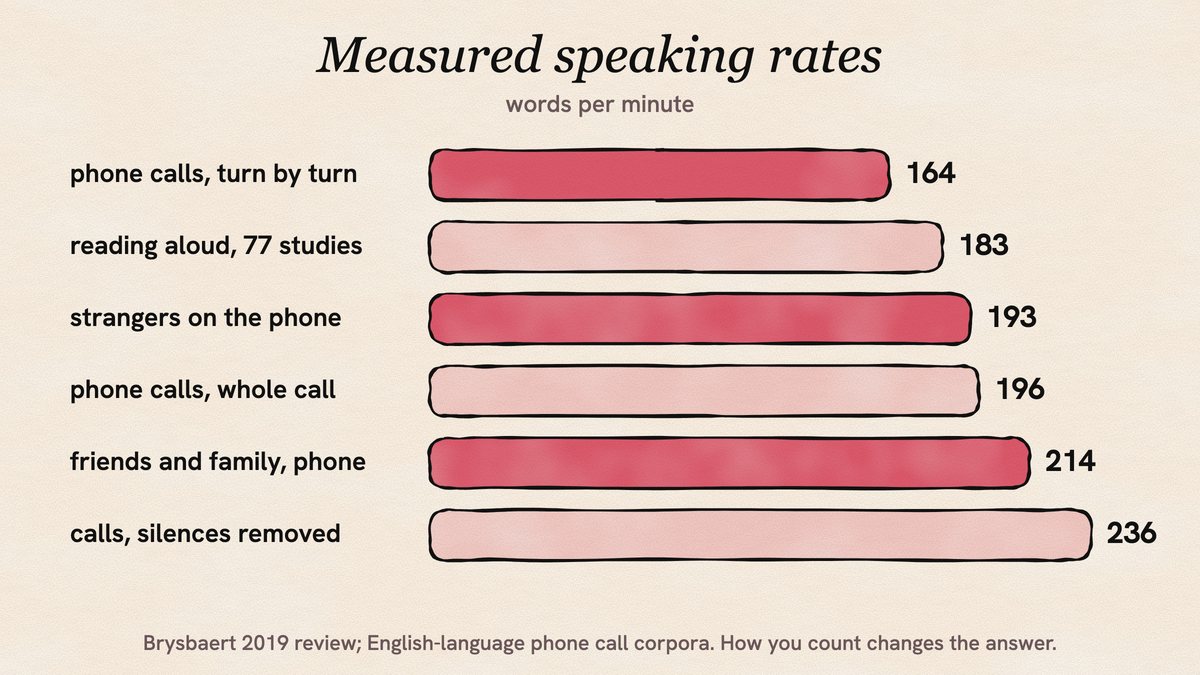
The same set of phone calls can give you three different speaking rates. Researchers at the University of Pennsylvania took 2,438 carefully aligned telephone conversations and counted the words. Divided by the total length of the calls, the average was 196 words per minute. With the silences cut out, it rose to 236. Counted turn by turn, it fell to 164 2.
Same talk, same people, three answers. So before you trust any "words per minute" figure, ask what was counted. Below are the rates we could trace to a study, and what they mean for your script.
How many words per minute do people speak?
In large sets of recorded English-language phone conversations, people averaged around 190 to 215 words per minute, counted over the whole call. Friends and family talking on the phone averaged 214. Strangers given a topic to discuss averaged 193 2. The authors note that the gap is only about 10% 2.
Topic made a difference too. In a separate analysis of part of the strangers' calls, the average rate ranged from 152 words per minute on some topics to nearly 170 on others 2. Men spoke slightly faster than women, by about 4 to 5 words per minute, or 2% 2.
Individual calls spread much wider. Counted over the whole call, single conversations ran from 111 to 291 words per minute 2. So the average is a fair place to start, and you may sit well above or below it.
How fast do people read aloud?
Most adults read aloud at around 183 words per minute. That figure comes from a review of 77 studies with 5,965 participants, in several languages that use the Latin alphabet 1. Weighting the studies by their size gave 180, and the median was 181 1, so the figure is steady however you slice it.
Reading tends to be slower than talking. In a study of 192 American speakers, from children to older adults, the speed of the words themselves was slower when they read sentences than when they talked freely 3. That study measured the pace of the words with pauses taken out, so it doesn't give words per minute. By our reading, it fits the gap between the reading figure of 183 and the 190 to 215 in phone calls 12.
A script sits between the two. You are reading, but you want it to sound like talk.
How many words fit in 15, 30, 60 and 90 seconds?
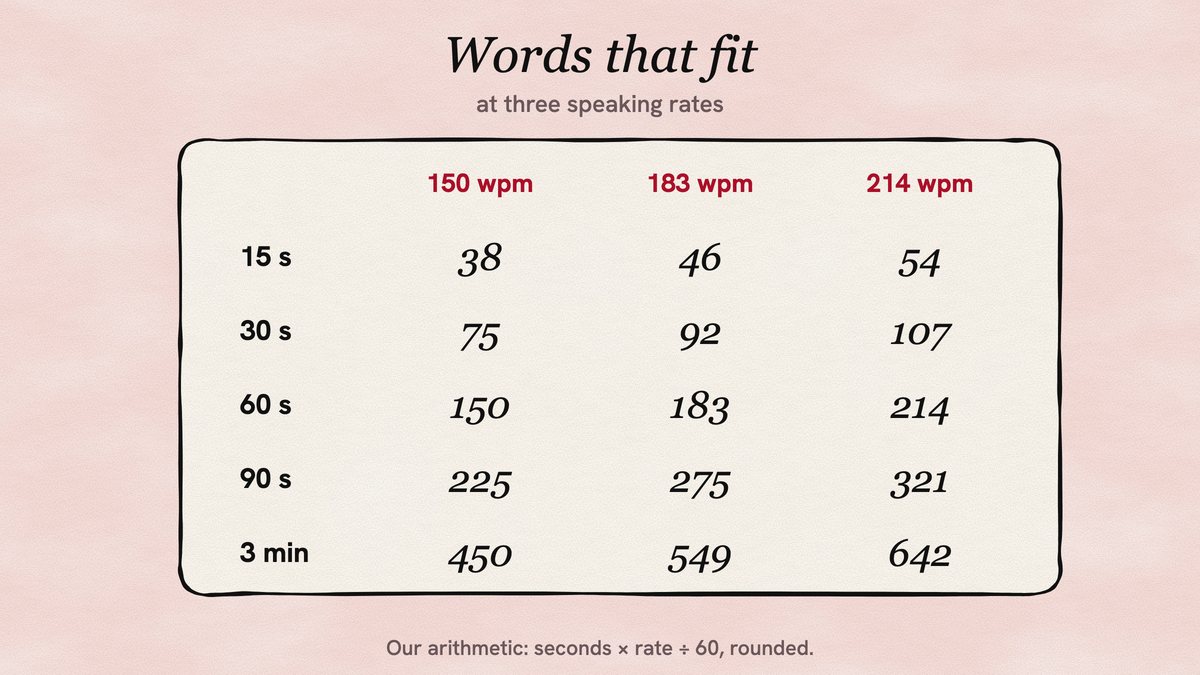
Multiply the rate by the seconds and divide by 60. Here is our arithmetic for three rates. The 150 is our own round number for a calm, deliberate read. The 183 is the average for reading aloud 1, and the 214 is the average for friends and family on the phone 2.
| Length | Calm read (150 wpm) | Reading-aloud average (183 wpm) | Lively talk (214 wpm) |
|---|---|---|---|
| 15 seconds | 38 words | 46 words | 54 words |
| 30 seconds | 75 words | 92 words | 107 words |
| 60 seconds | 150 words | 183 words | 214 words |
| 90 seconds | 225 words | 275 words | 321 words |
| 3 minutes | 450 words | 549 words | 642 words |
For example, 60 seconds at 183 words per minute is 183 × 60 ÷ 60 = 183 words. Thirty seconds at 214 is 214 × 30 ÷ 60 = 107 words. Numbers are rounded to the nearest word.
If you are new to reading on camera, start from the middle column and cut. A script that is a little short leaves room for pauses, and pauses are cheap.
Why does the same script run long or short?
Pauses change the clock more than they change how fast you sound. Your rate in words per minute depends on how fast you say the words and on how many pauses you take and how long they are 4. Listeners judging how fast someone speaks weigh the speed of the words much more than the pauses 4.
By our reading, that means you can take a breath at each full stop without seeming slow. It also explains why edited video can feel quick. In the phone-call study, cutting out the silences raised the average from 196 to 236 words per minute 2. If you trim every gap in the edit, a 183-word script may well land under 60 seconds.
How fast is too fast?
Listeners kept up with speech played at 270 words per minute in one experiment, but their understanding dropped steeply at 315 5. The abstract doesn't say how many people took part. That gives you a ceiling well above any of the averages here, so a brisk script is unlikely to lose people on speed alone. A cluttered or rushed one can still lose them for other reasons.
What doesn't the research show?
We found no research that measured speaking rates in short social videos. The conversation figures come from English-language phone calls between two people 2, and the reading figure pools published studies in several languages 1. A video script is read, edited and spoken to a lens, which none of these studies looked at. Treat the table as a planning range, then time your own reading.
Steps to try today
- Pick a paragraph from a script you have already written.
- Read it aloud at the pace you'd use on camera and time it with your phone.
- Count the words, multiply by 60 and divide by your seconds. That is your rate.
- Multiply your rate by your target length in seconds and divide by 60.
- Write to that number, then film one take and check the length.
If you'd like to hear the pace before you film, YapPlease, the teleprompter we built, can read a script aloud to you and then scroll it under the lens as you speak.
Common questions
How many words is a 60-second speech?
About 150 to 215 words for most people. A review of 77 studies found an average reading-aloud rate of 183 words per minute 1, and friends and family on the phone averaged 214 2. Time one paragraph of your own to find where you sit.
What is the average speaking rate in words per minute?
It depends on how it is counted. In 2,438 English-language phone calls, the average was 196 words per minute over the whole call, 236 with silences removed and 164 counted turn by turn 2. For reading aloud, the average across 77 studies was 183 1.
How many words is a 30-second script?
By our arithmetic, about 75 to 107 words: 75 at a calm 150 words per minute, 92 at the reading-aloud average of 183 1, and 107 at the 214 measured for friends and family on the phone 2.
How long does a 500-word script take to read?
At the reading-aloud average of 183 words per minute 1, 500 words take about 2 minutes 44 seconds, by our arithmetic. At 150 words per minute it is about 3 minutes 20 seconds, and at 214 it is about 2 minutes 20 seconds.
Sources
- Brysbaert M (2019). How many words do we read per minute? A review and meta-analysis of reading rate. Journal of Memory and Language 109:104047. DOI
- Yuan J, Liberman M, Cieri C (2006). Towards an integrated understanding of speaking rate in conversation. Proceedings of Interspeech 2006. DOI
- Jacewicz E, Fox RA, Wei L (2010). Between-speaker and within-speaker variation in speech tempo of American English. Journal of the Acoustical Society of America 128(2):839-850. PubMed
- Grosjean F, Lane H (1976). How the listener integrates the components of speaking rate. Journal of Experimental Psychology: Human Perception and Performance 2(4):538-543. PubMed
- Kuperman V, Kyröläinen AJ, Porretta V, Brysbaert M, Yang S (2021). A lingering question addressed: Reading rate and most efficient listening rate are highly similar. Journal of Experimental Psychology: Human Perception and Performance 47(8):1103-1112. PubMed
Keep reading
How to write a script for Reels and TikTok
A fill-in reel script template, a 30-second example, current length limits from Instagram and TikTok, and how many words fit in 15 to 90 seconds.
How to read a script without looking like you're reading
Viewers are sharp at spotting where eyes point, yet loose about what counts as eye contact. Use that: short lines, text near the lens, calm pace.
How to sound natural reading a script
Listeners can hear reading even with the words filtered out. What small speech studies show about why scripts sound read, and how to fix yours.