
Talking head video setup on an iPhone
In this article
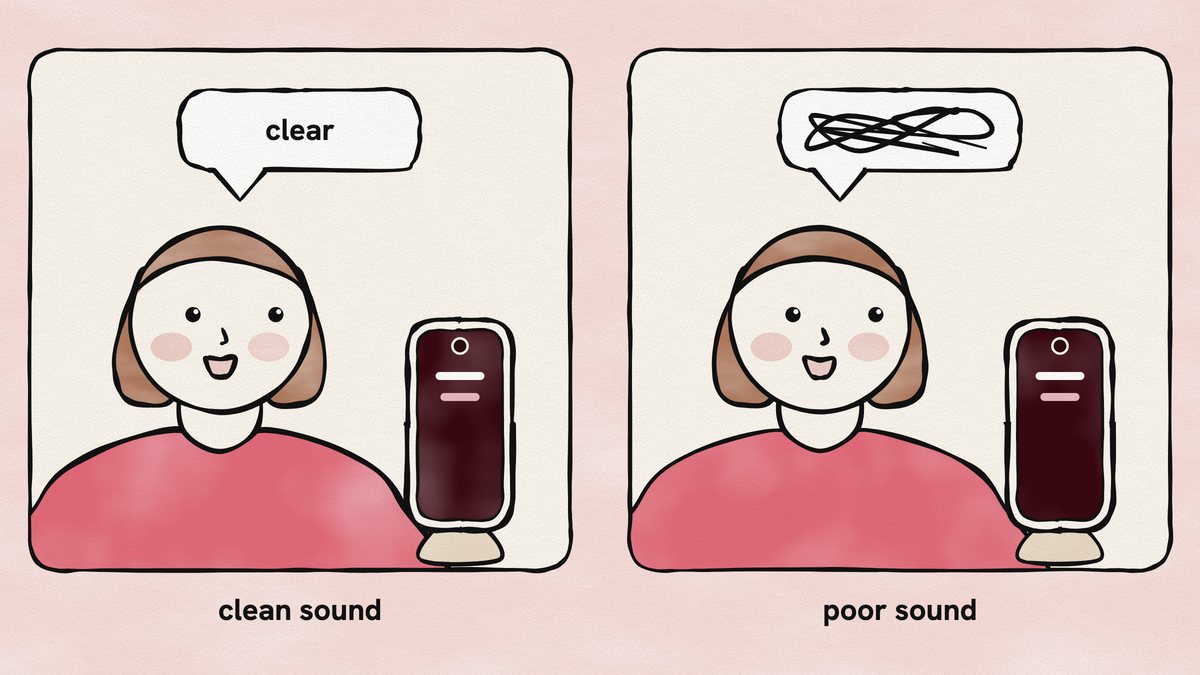
Two researchers took the same conference talks and the same radio interviews with scientists and played them to people in either good or poor audio quality. The words were identical. People still rated the research and the researcher less favorably when the sound was poor 1.
In the first experiment, 97 people watched two- or three-minute clips of conference talks on engineering and physics. In the second, 99 other people heard clips from NPR's Science Friday 2. The authors' summary, quoted in a USC news release, was that viewers thought the talk was worse and the speaker less intelligent and less likeable when the video was hard to hear 2.
That is why a talking head setup starts with sound, and only then with light and camera.
What is a talking head video?
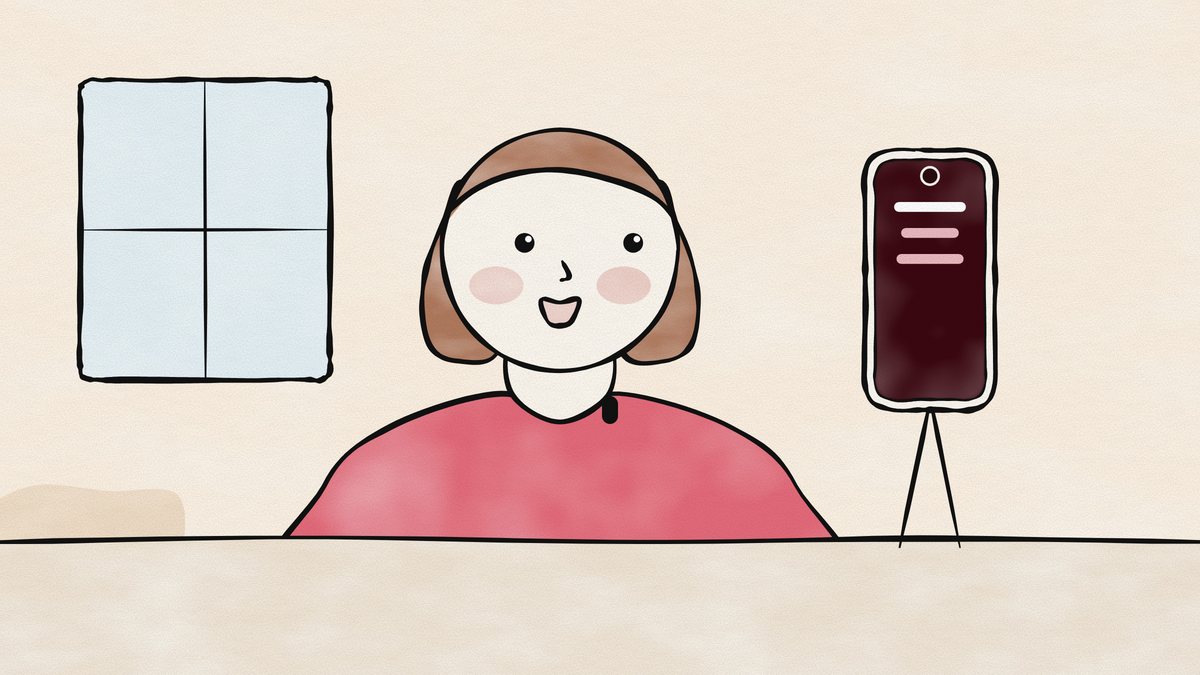
A talking head video is one person speaking to the camera, framed from about the chest up. It is the standard format for tips, explainers, course lessons, founder updates and most Reels and TikToks where someone teaches something. Because there is little else on screen, your voice, your eyes and your light carry the whole video.
Why does sound quality matter so much?
Poor sound changes how people judge you, even when your words stay the same. In the study above, the same talks and interviews were rated less favorably when only the audio was worse 1. The researchers studied scientists talking about their work, and the abstract doesn't give the size of the effect, so we can't say how much a slightly echoey kitchen would cost a creator. The direction is clear enough to act on.
How to get good sound on an iPhone, as practical advice:
- Get the mic close. A small clip-on mic on your collar beats the phone's built-in mic at arm's length. If you only have the phone, move it closer and accept a tighter frame.
- Choose a soft room. Curtains, a rug, a sofa and a bookshelf soak up echo. Bare walls and tiled floors bounce it back.
- Switch off the hum. Fridges, fans and air conditioning are easy to stop hearing and easy to hear on playback.
- Test with headphones. Record ten seconds and listen before you film the whole script.
Where should the phone go?
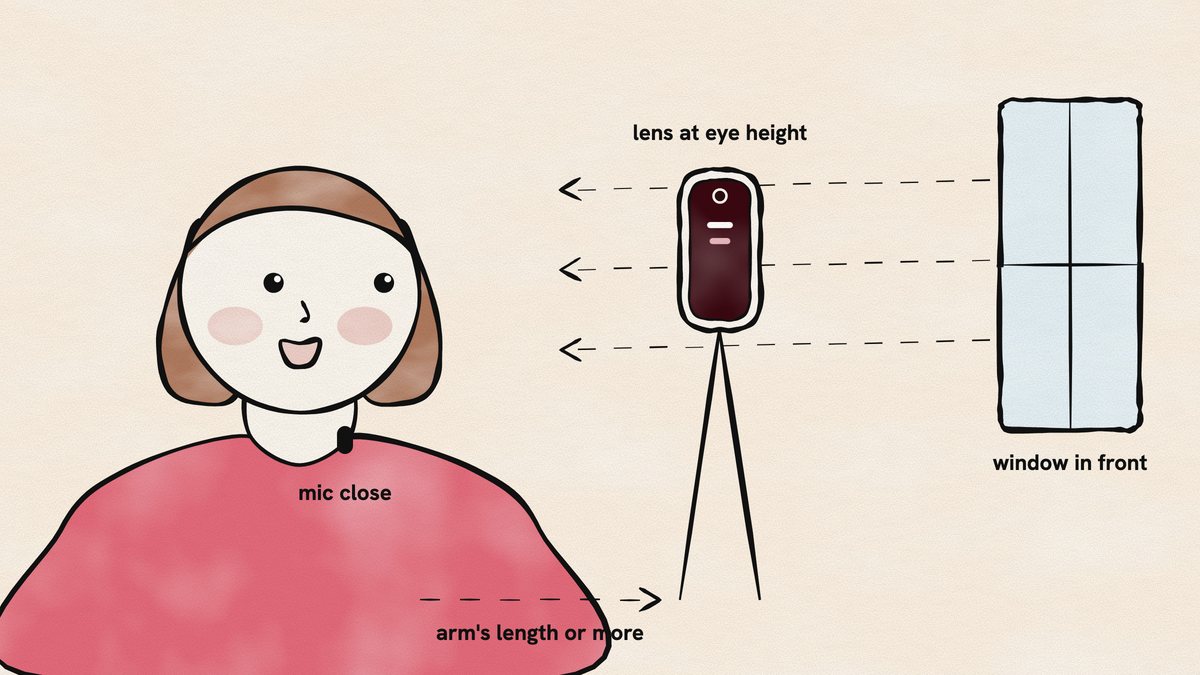
Put the lens at eye height, straight in front of you. A phone below your face looks up your nose, and a phone above looks down on you.
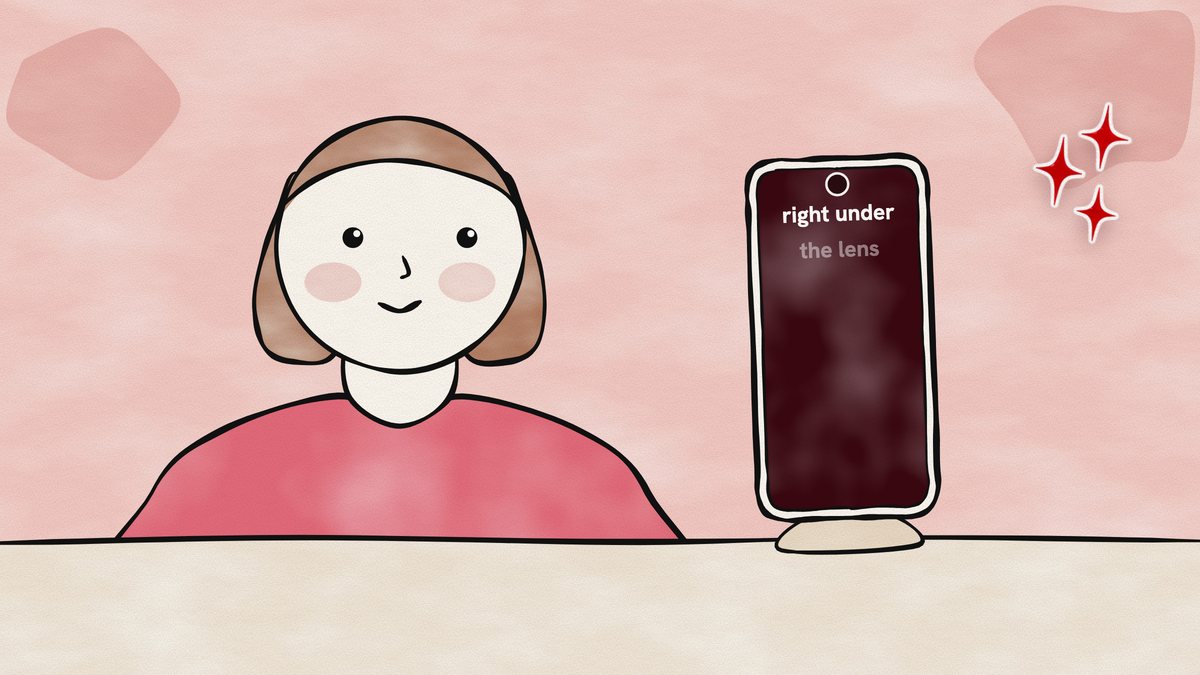
Then look at the lens, or just below it. In an experiment with 16 Stanford students and recent graduates as viewers, eye contact was lost when a speaker looked about 1 degree above or to the side of the camera, while viewers were far less sensitive when the speaker looked below it 3. For a phone held 1 foot away, the author worked out that a 5 degree gap is about 1 inch 3. That is why notes or a teleprompter belong just under the lens, never off to the side.
Give yourself some distance. In a study of video consultations, 53 viewers saw better eye contact at a 7 degree gaze angle than at 15 degrees in 87% of cases, and the authors suggest sitting further from the camera to improve eye contact 4. Arm's length or a little more is a good start, as long as your mic stays close.
How should you light a talking head video?
Face a window. Daylight from in front of you is soft and even, and it costs nothing. This is advice from practice, since we found no research comparing lighting setups for this kind of video.
- Window in front or slightly to one side. Light falling across one side of your face adds shape. Full sun through the glass is harsh, so a thin curtain helps.
- Never with the window behind you. The phone exposes for the bright window and your face goes dark.
- Turn off the overhead light if it throws shadows under your eyes, or if its colour clashes with daylight.
- Film at the same time of day if you are making a series, so the videos match.
How should you frame yourself?
Frame from the middle of the chest to just above your head, with your eyes about a third of the way down the screen. For Reels and TikTok, film vertically. Leave a little room above your head, since captions and app buttons sit at the top and bottom of the screen.
Keep the background simple and a step or two behind you. A plant, a lamp or a shelf gives depth. A blank wall right behind your head looks flat, and a busy room pulls eyes away from your face.
How do you make talking head videos more engaging?
Look at the viewer and speak without obvious notes. In a study of instructor videos, viewers rated a speaker who kept eye contact and spoke fluidly without notes higher on preparedness and effectiveness than a version where the instructor slumped, looked away and used notes, though how much viewers learned didn't differ significantly 5. Posture, eye contact and fluency all changed together, so the study can't say which one mattered most.
Practical habits that help:
- One idea per video. A short script with a clear point is easier to deliver with energy.
- Several takes. Your third take usually sounds more like you than your first. Leave a second of silence at the start and end of each to give yourself room to cut.
- Cut the warm-up. Start with the sentence that says what the viewer gets.
- Change the shot now and then. A slightly tighter crop at the main point gives the eye something new without a second camera.
What doesn't the research show?
We found no test of talking head setups on social media. The sound study used scientists' talks and radio interviews 1, the eye contact studies used lab videos and still images from video consultations 34, and the instructor study changed several things at once 5. Use these findings to set priorities, and use your own playback to judge the result.
What can you set up today?
- Find the quietest, softest room you have.
- Sit facing a window.
- Put the phone at eye height, arm's length or further away.
- Clip a mic to your collar, or move the phone closer.
- Frame chest to just above your head, eyes a third of the way down.
- Record ten seconds, check the sound with headphones, then film three takes.
If you read from a script, keep it right under the lens. On an iPhone, YapPlease scrolls your script over the camera view close to the lens and can follow your voice while you record.
Common questions
What is the best setup for a talking head video?
Good sound, light from a window in front of you, and the phone at eye height at arm's length or further. Start with sound: in two experiments, people rated the same scientists and their research less favorably when the audio quality was low 1.
Where should I look when filming a talking head video?
At the lens or just below it. In a study with 16 viewers, eye contact was lost after about 1 degree when the speaker looked above or beside the camera, and viewers were far less sensitive to a gaze just below it 3.
How far should the phone be when filming yourself?
Arm's length or a little more, with the mic close to you. In a study of video consultations, 53 viewers preferred the eye contact at a 7 degree gaze angle over 15 degrees in 87% of cases, and the authors suggest more distance from the camera to improve eye contact 4.
Do I need a microphone for talking head videos?
A small clip-on mic is the simplest upgrade, because it puts the mic close to your mouth while the phone stays further away. If you only have the phone, move it closer and pick a quiet, soft room.
Sources
- Newman EJ, Schwarz N (2018). Good sound, good research: how audio quality influences perceptions of the research and researcher. Science Communication 40(2):246-257. DOI
- Gersema E (2018). Audio quality influences whether you believe what you hear. USC Dornsife News, 23 April 2018 (read 20 November 2026). dornsife.usc.edu
- Chen M (2002). Leveraging the asymmetric sensitivity of eye contact for videoconferencing. Proceedings of the SIGCHI Conference on Human Factors in Computing Systems (CHI 2002), 49-56. DOI
- Tam T, Cafazzo JA, Seto E, Salenieks ME, Rossos PG (2007). Perception of eye contact in video teleconsultation. Journal of Telemedicine and Telecare 13(1):35-39. PubMed
- Carpenter SK, Wilford MM, Kornell N, Mullaney KM (2013). Appearances can be deceiving: instructor fluency increases perceptions of learning without increasing actual learning. Psychonomic Bulletin & Review 20(6):1350-1356. PubMed
Keep reading
How to use a teleprompter on your phone
Where to put the text, how big to make it, how fast to scroll, and when voice-follow beats a fixed speed, for TikTok, Reels and YouTube.
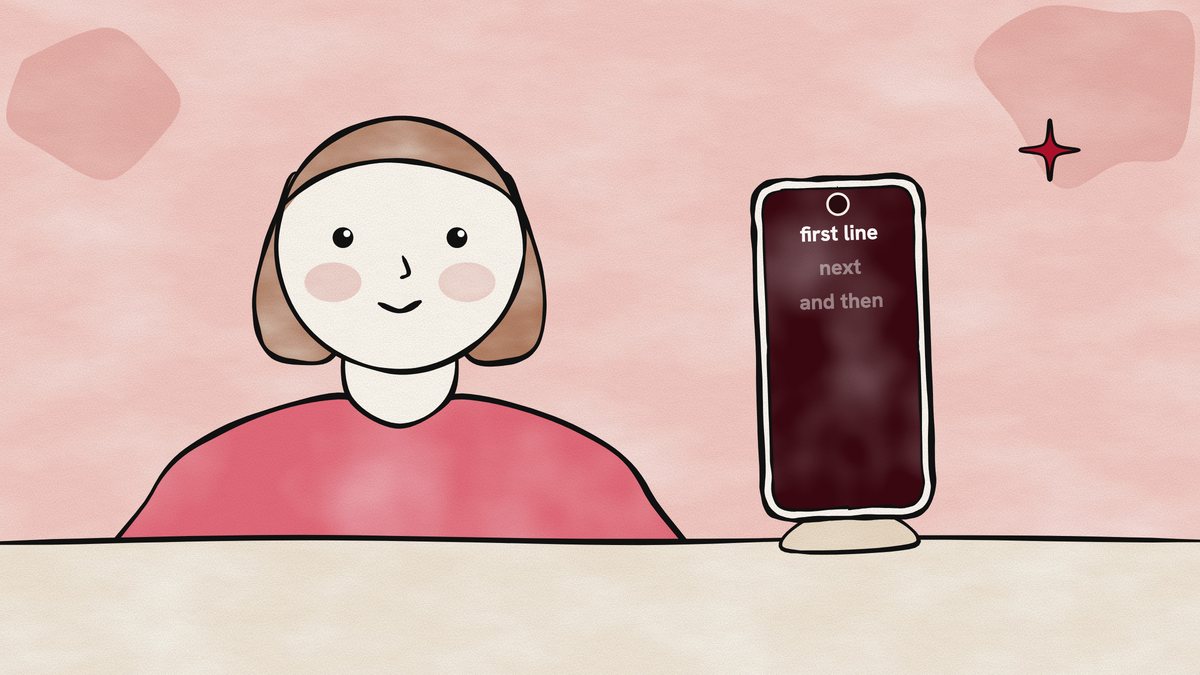
How to look at the camera while reading a script
Gaze studies say eye contact survives a few degrees off the lens. Here is how that turns into centimetres on your phone, and where to put the words.
Why do I sound weird on video?
You hear your own voice through your skull as well as the air, and a phone mic hears only the air. What the research says, and how to get used to it.