
How to stop saying um
In this article
In one study, a team of researchers coded roughly 192,000 words of conversation, spoken by 48 pairs of adults 1. On average the speakers produced 5.97 disfluencies every 100 words 1. That count includes repeated words and restarted sentences as well as fillers like uh and um.
By our arithmetic, that's one about every 17 words. Ordinary conversation is full of them. On camera you hear every one on playback, which is why so many people go looking for a fix.
Why do people say um and uh?
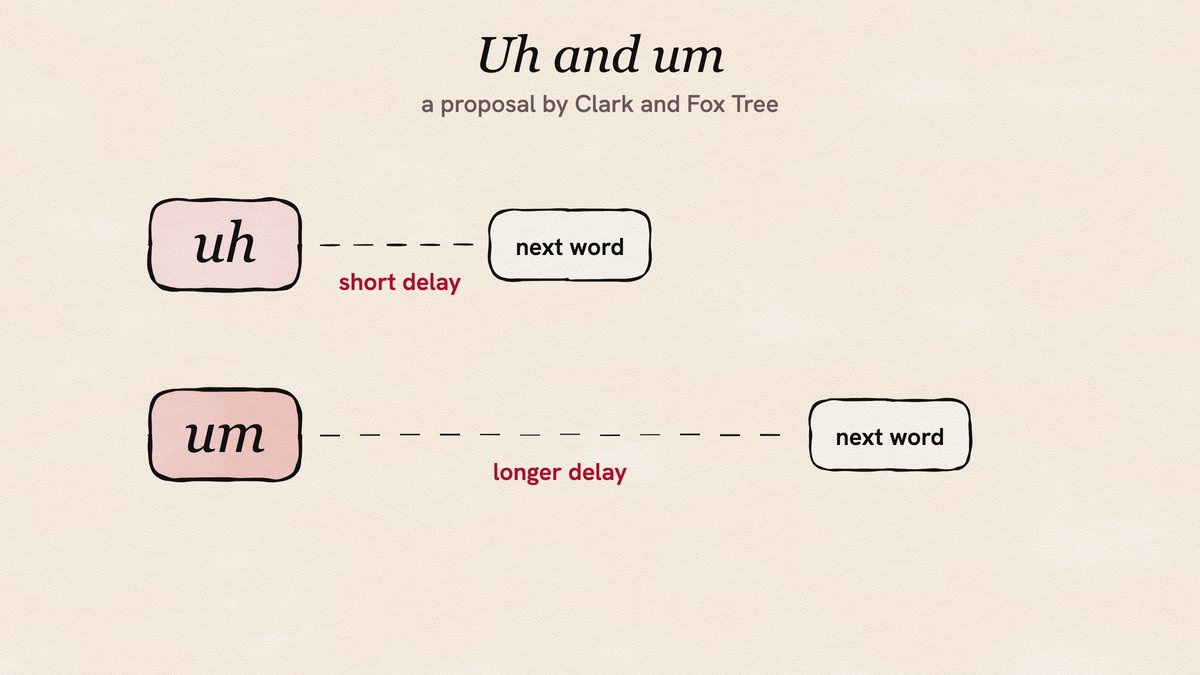
Um and uh are words that announce a pause, and the research suggests speakers choose them. Herbert Clark and Jean Fox Tree studied several large collections of recorded spontaneous speech and proposed that speakers use uh to signal a minor delay and um to signal a major one 2. On their reading, "uh and um are conventional English words, and speakers plan for, formulate, and produce them just as they would any word" 2.
That changes how you might think about the habit. An um isn't random noise leaking out. It's your mouth telling the listener, "hang on, I'm still building the next bit."
When do fillers show up most?
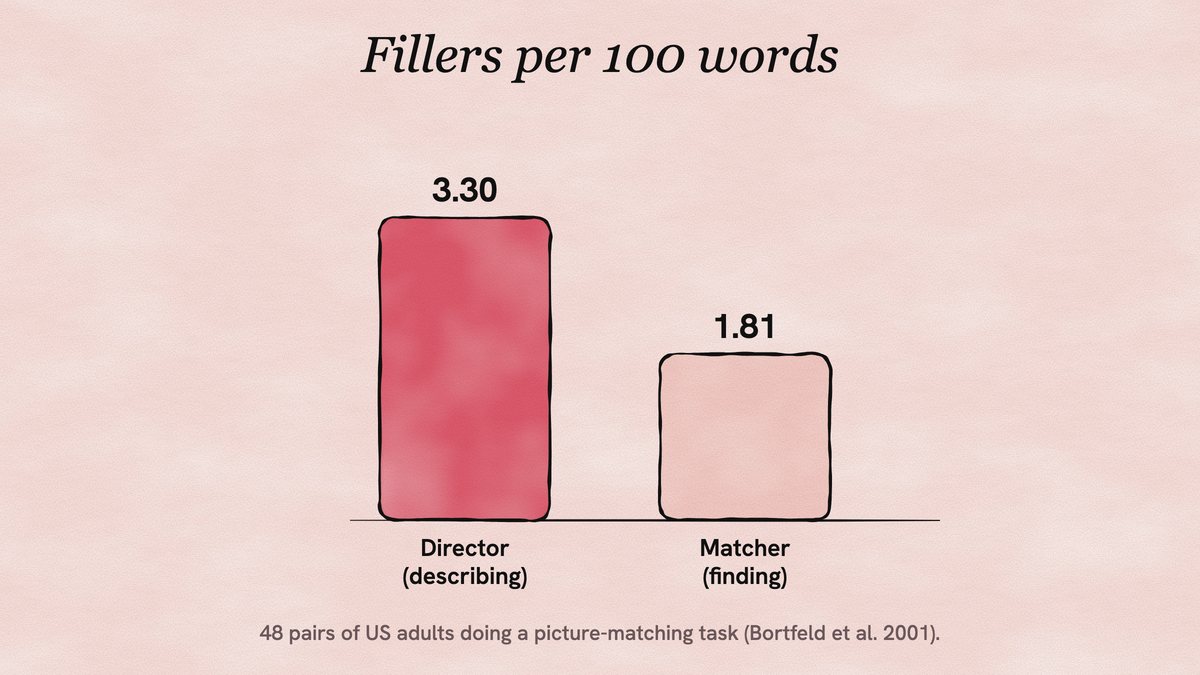
Fillers rise when you have more to plan. In the Bortfeld study, one person in each pair described pictures (the director) while the other found them (the matcher). The pairs were married, college-educated US adults, half of them talking with their own spouse and half with a stranger 1. Directors produced 3.30 fillers per 100 words, against 1.81 for matchers 1. The authors concluded that "disfluencies are associated with an increase in planning difficulty" 1.
The same study found that men used more fillers than women, 3.04 against 2.07 per 100 words 1. That's one study of task talk between couples and strangers. It says nothing about how you, personally, sound in an interview.
So the moments you say um most are probably the moments you're working hardest: answering a question you didn't expect, explaining something abstract, or filming without notes.
Does saying um make you sound less confident?
The honest answer is "a little, sometimes." A 2026 study by Lee and Papafragou used clips of spontaneous speech, where most earlier work had used scripted, lab-recorded speech 3. Filled pauses did not change how competent, trustworthy or warm listeners judged the speaker to be as a person 3. Within a single conversation, though, speakers who used them were rated as less trustworthy, less ready and less certain 3. In a fourth experiment, speakers who used filled pauses were more likely to be avoided in future interactions 3.
There may even be an upside for listeners. In studies in English and Dutch, hearing uh helped people recognise the words that came next, while um neither helped nor hurt 4.
Put together, a few ums won't sink you. A lot of them in a short video, where you're asking for trust in under a minute, may cost you some.
Can you train yourself to stop saying um?
You can, at least in the small studies we found, and the main ingredient is noticing. A 2022 review counted 7 studies in one journal, published from 2016 to 2022, that tested habit reversal training for filled pauses in public speaking 5. Three studies from that journal give a sense of the method:
- 6 participants giving speeches: after training in awareness (spotting each filler) and a competing response (doing something else instead), all 6 "exhibited an immediate decrease in filled pauses" 6.
- 4 university students giving short speeches: awareness training alone cut ums, tongue clicks and stray "like"s for all four. Each needed booster sessions for further gains, and the gains generally held in front of a small audience 7.
- College students giving speeches: awareness training alone worked for every participant, this time without boosters 8.
These are tiny studies, with a trainer in the room. The abstracts we read don't say how long the gains lasted after the study ended, and we found no trial of people training themselves at home with a phone. The method is still easy to borrow: hear the habit, catch it as it happens, and put something else in its place.
Does reading from a script cut fillers?
We found no study that measured fillers in scripted versus unscripted video, so this part is our reasoning. If fillers rise with planning load 1, and um announces a delay while you plan 2, then a script should remove some of the reason for them, because the words are already planned.
The trade-off is that reading can make you sound read. The best middle ground is a script written the way you talk, read slowly enough that you can look like you're thinking.
What can you try today?
Here's a short routine built from the awareness training idea. It uses only your phone.
- Record a two-minute baseline. Talk to the camera about something you know well, with no notes. Don't try to be good.
- Count every um and uh. Play it back and make a tally. This is the awareness part, and it's often the most surprising.
- Pick your replacement. Close your mouth and take a short, silent breath where the um would go. A short pause gives you the same thinking time without the sound. Our guess is that it will feel much longer to you than it looks.
- Catch it live. Record again on the same topic. When you feel an um coming, pause instead. Stop and restart the take if you need to.
- Plan your hardest parts. Write down the opening line and any tricky explanation. Those are the high-planning moments where fillers cluster.
- Count again. Compare the two tallies. Repeat the routine on a new topic in a few days, since everyone in one student study needed booster sessions.
If you film from a full script, a teleprompter helps with step 5 for the whole video. We built YapPlease for that: the script scrolls next to the lens and follows your voice, and it waits when you pause.
Common questions
Why do I say um so much?
Fillers rise when you're planning hard. In a study of 48 pairs of US adults, the person describing pictures used 3.30 fillers per 100 words, against 1.81 for the person listening and finding them 1. Clark and Fox Tree propose that um announces a longer delay while you plan what comes next 2. Lots of ums usually means lots of on-the-spot planning.
Is it bad to say um in an interview?
It can cost you a little. In a 2026 study using spontaneous speech, filled pauses didn't change how competent, trustworthy or warm a speaker seemed as a person, but within a conversation they lowered ratings of trust, readiness and certainty 3. A short silent pause is a safer way to buy thinking time.
How long does it take to stop saying um?
The studies we read don't give a timeline you can rely on. In one with 4 university students, awareness training cut fillers for all four, and each needed booster sessions to improve further 7. Another found awareness training worked for every participant without boosters 8. Plan on a few practice sessions, not one.
What is the difference between um and uh?
Clark and Fox Tree propose that uh signals a short delay and um a longer one 2. Listeners seem to treat them differently too: in studies in English and Dutch, hearing uh helped people recognise the next words, while um had no effect either way 4.
How do I stop saying um and like when presenting?
Use the same steps for both. Record yourself, count each filler, then practise pausing silently where it would go. One habit reversal study counted um, uh, er, clicking sounds and misused "like" together as filled pauses, and they dropped for all 6 participants 6.
Sources
- Bortfeld H, Leon SD, Bloom JE, Schober MF, Brennan SE (2001). Disfluency rates in conversation: effects of age, relationship, topic, role, and gender. Language and Speech 44(2):123-147. PubMed
- Clark HH, Fox Tree JE (2002). Using uh and um in spontaneous speaking. Cognition 84(1):73-111. PubMed
- Lee JHN, Papafragou A (2027). Does disfluency affect social judgments and decisions? Evidence from spontaneous speech. Cognition 278:106697 (online 2026). PubMed
- Fox Tree JE (2001). Listeners' uses of um and uh in speech comprehension. Memory & Cognition 29(2):320-326. PubMed
- Luiselli JK (2022). Public speaking disfluencies: A review of habit reversal training and research. Journal of Applied Behavior Analysis 55(4):1342-1348. PubMed
- Mancuso C, Miltenberger RG (2016). Using habit reversal to decrease filled pauses in public speaking. Journal of Applied Behavior Analysis 49(1):188-192. PubMed
- Spieler C, Miltenberger R (2017). Using awareness training to decrease nervous habits during public speaking. Journal of Applied Behavior Analysis 50(1):38-47. PubMed
- Montes CC, Heinicke MR, Geierman DM (2019). Awareness training reduces college students' speech disfluencies in public speaking. Journal of Applied Behavior Analysis 52(3):746-755. PubMed
Keep reading
How to be confident on camera
You look calmer than you feel. What speaking research says about nerves, "get excited" self-talk and practice, and steps to try before your next take.
How to sound natural reading a script
Listeners can hear reading even with the words filtered out. What small speech studies show about why scripts sound read, and how to fix yours.
How to read a script without looking like you're reading
Viewers are sharp at spotting where eyes point, yet loose about what counts as eye contact. Use that: short lines, text near the lens, calm pace.